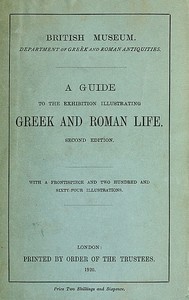
A Guide to the Exhibition Illustrating Greek and Roman Life Book Summary
Introduction
"A Guide to the Exhibition Illustrating Greek and Roman Life" is a product of the early 20th-century academic world, stemming from a specific exhibition curated to showcase the everyday lives of people in ancient Greece and Rome through their art. While not a primary historical text, it serves as a fascinating artifact of early 20th-century scholarship and interpretation in the field of classical archaeology and art history.
What is this book about?
This volume primarily functions as a catalogue and guide to an earlier exhibition. It compiles illustrations, drawings, and textual descriptions of artifacts, vase paintings, sculptures, and other artworks that depict scenes of daily life, mythology, war, and peace in the ancient Greek and Roman worlds. The text explains the significance of these illustrations, aiming to interpret them as visual records of past cultures. It reflects the interpretive frameworks and limited understanding of ancient life prevalent during the time it was written (circa 1938), showcasing the methods used by scholars to reconstruct the past from fragmentary visual evidence. It's less a general history of ancient life and more a scholarly exploration and presentation of visual evidence for it.
Key Lessons
Interpreting Visual Evidence: The book delves into how seemingly mundane images on pottery, frescoes, or coins can be complex sources of historical information. For instance, depicting a symposium scene isn't just about partying; it reveals social structures, dining habits, gender roles, and even philosophical discussions prevalent in ancient Greece. The book guides the reader through the process of looking beyond the surface, considering the context, the artist's potential biases, and the conventions of representation in ancient art.
Challenges of Reconstructing the Past: It implicitly highlights the difficulties scholars faced in the early 20th century in interpreting these visual depictions. Limited excavation data, stylistic conventions that might distort reality, and a lack of written records for certain aspects of daily life created significant interpretive hurdles. The guide helps readers understand that ancient 'illustrations' are not always straightforward documentaries but are products of their own time and artistic traditions.
Connecting Art to Society: The book emphasizes that art was not isolated from society. Illustrations of marketplaces, games, religious rituals, and family life provide invaluable glimpses into the social fabric, economic activities, and cultural beliefs of ancient Greeks and Romans. By analyzing these images, the book demonstrates how we can infer details about daily routines, occupations, religious practices, and entertainment that are otherwise lost to time.
Evolution of Interpretation: As a product of its era, the book reflects the prevailing theories and assumptions of its time. Comparing its interpretations with modern scholarship can be insightful. It shows how our understanding of the past evolves as new evidence comes to light, archaeological techniques improve, and interdisciplinary approaches (combining art history, archaeology, literature, anthropology) become more common. This historical snapshot is valuable for seeing the development of classical studies.
Is this book fit for me?
This book is primarily intended for:
- Students and scholars of Classical Archaeology and Art History: It offers a historical perspective on how past eras were interpreted visually.
- Museum-goers and curators: It provides insight into the challenges and methods of creating exhibitions about ancient life.
- Those interested in the history of scholarship: It's a window into early 20th-century academic methods and the evolution of classical studies.
- Fans of visual history and iconography: The illustrations and focus on 'depictions' are of direct interest.
If you're looking for a general, engaging overview of daily life in ancient Greece and Rome suitable for popular reading, this guide might be less fulfilling due to its academic focus and specific nature as an exhibition catalogue.
Does it still matter today?
Yes, it still matters today, but perhaps in a different way.
The fundamental questions of interpreting visual evidence and understanding how art reflects society remain crucial in archaeology and art history. The book provides a baseline for seeing how interpretations have changed. It demonstrates the challenges inherent in reconstructing the past solely from visual sources, which remains relevant for any field dealing with incomplete historical records. It's a valuable historical document showing the state of knowledge and methodology at a specific point in time.
| Reading on Gutenburg | Free reading |
| Get Paperback Version on Amazon | Buy a book |
| Suggest Book : The Family: A World History Book | Get on Amazon |
Conclusion
"A Guide to the Exhibition Illustrating Greek and Roman Life" is a specialized, academic work from the early 20th century. It serves best as a niche resource for those specifically interested in the history of classical scholarship, exhibition curation, or the detailed interpretation of ancient visual art. While not a general history of daily life, it offers valuable insights into how ancient art was perceived and used to understand the past by its creators. Its historical value lies in documenting an earlier approach to a timeless subject: deciphering the visual clues left by past civilizations. For a broader overview of ancient Greek and Roman life, one might consult modern popular histories.