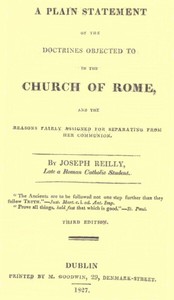
A Plain Statement of the Doctrines Objected to in the Church of Rome And the Reasons Fairly Assigned for Separating From Her Communion Book Summary
Introduction
This book provides a concise and direct critique of various doctrines and practices of the Roman Catholic Church during the 17th century. Authored by William Gifford, a prominent English Nonconformist minister, it serves as a clear statement of the theological objections held by many Protestants of his time against the established Catholic church.
What is this book about?
'A Plain Statement of the Doctrines Objected to in the Church of Rome' is a polemical work arguing against several key teachings and practices of the Roman Catholic Church. Gifford systematically outlines his objections to doctrines such as Purgatory, the Mass as a sacrifice, the doctrine of Penance, the Immaculate Conception of Mary, Papal supremacy, and the veneration of saints. He provides justifications for why those who hold these beliefs should separate themselves from the Catholic Communion, framing his arguments within the context of Scripture and Protestant theology.
Key Lessons
The book offers a clear articulation of common Protestant objections to Catholicism during the English Civil War era. One major lesson is the detailed rejection of Purgatory, contrasting the Catholic teaching of a post-death purification with the Protestant belief in direct entry into Heaven or Hell based on Christ's atonement. Gifford argues that praying for the dead and offering Masses for their souls distracts from Christ's finished work on the cross.
Another central theme is the critique of the Mass, particularly the Catholic understanding of it as an actual propitiatory sacrifice offered by Christ through the priest. Gifford emphasizes that Christ offered himself once for all, and the Lord's Supper is a commemoration and spiritual participation in that sacrifice, not a repeat offering. He also strongly opposes the idea of Penance as a meritorious work required for salvation, stressing justification by faith alone.
The author challenges the authority attributed to the Pope and practices like praying to saints and Mary. He argues that Scripture alone is the ultimate authority (Sola Scriptura), and therefore no intermediary, whether Pope or saint, holds divinely delegated authority to forgive sins or grant salvation. This leads to his call for separation from the Church of Rome, viewing it as fundamentally opposed to the true church established by Christ.
Overall, the book serves as a powerful statement of faith for its author and his contemporaries, delineating the boundaries of acceptable Christian doctrine as they understood them from a Calvinist perspective and providing a rationale for exclusion from the Roman Catholic communion.
Is this book fit for me?
If you are interested in historical Protestant-Catholic polemics, the development of Reformation thought, or seventeenth-century English religious life, this book is highly relevant. It provides valuable insight into the specific theological objections that fueled the Separatist movement in England. Readers seeking a direct, historically situated argument for Reformation principles from a contemporary figure will find this text useful. However, if you are looking for a comprehensive modern treatment of the relationship between Protestantism and Catholicism, or a detailed historical analysis of the Reformation beyond polemics, you might find this book too focused or dated.
Does it still matter today?
Yes, this book still matters, primarily as a historical document. It offers a window into the intense theological debates and deep-seated fears that shaped early modern English religious identity and the trajectory of the Protestant Reformation. Understanding the specific arguments used by figures like Gifford helps illuminate the historical context behind contemporary ecumenical dialogues and ongoing discussions about the nature of the church, salvation, and sacraments. It demonstrates the enduring power of certain core Protestant doctrines (like Sola Scriptura, Justification by Faith alone, and the view of the Lord's Supper) as points of contention.
However, while the core theological issues addressed (like Purgatory, the Mass as sacrifice, Papal authority) remain central points of division between some Protestant and Catholic traditions, the specific polemical style and historical context of Gifford's work might feel less immediate to a modern reader. The intense fear of being 'defiled' by association with the Pope or the idea of the 'invisible' Church might not resonate in the same way today.
Given this, a newer book might offer a clearer, more contemporary exploration of these enduring theological differences.
| Reading on Gutenburg | Free reading |
| Get Paperback Version on Amazon | Buy a book |
| Suggest Book : The Catholic Church: The First 1500 Years by Diarmaid MacCulloch Book | Get on Amazon |
Conclusion
In conclusion, 'A Plain Statement...' by William Gifford is a significant piece of 17th-century religious literature. It powerfully articulates the core theological objections of a key segment of English Protestantism towards the Roman Catholic Church, providing valuable historical insight into the Reformation era and the specific arguments used to justify separation. While its polemical nature and historical context make it less suitable as a primary source for modern interfaith dialogue or as a general introduction to the history of Christianity, it remains an important work for understanding the depth and rationale of early modern religious dissent. For a more contemporary overview of the full history of the Catholic Church, 'The Catholic Church: The First 1500 Years' by Diarmaid MacCulloch is recommended. Tags : History - Religious Philosophy & Ethics Religion/Spirituality/Paranormal