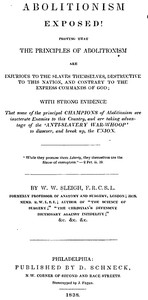
Abolitionism Exposed! Proving the the Principles of Abolitionism are Injurious to the Slaves Themselves, Destructive to This Nation, and Contrary to the Express Commands of God Book Summary
Introduction
This summary provides an overview of "Abolitionism Exposed! Proving the the Principles of Abolitionism are Injurious to the Slaves Themselves, Destructive to This Nation, and Contrary to the Express Commands of God." This text, originating from the 19th century, represents a pro-slavery perspective arguing against the abolitionist movement of that era.
What is this book about?
"Abolitionism Exposed!" is a pamphlet published in the 19th century. Its central argument is a defense of slavery, contending that the abolitionist movement's principles are actually harmful to enslaved African Americans, destructive to the United States as a whole, and contrary to biblical law as interpreted by the author. The author uses various arguments to support these positions, reflecting the pro-slavery viewpoints prevalent at the time.
Key Lessons
The book's core arguments, though representing a now-condemned perspective, offer historical insight:
1. Misinterpretation of Abolitionism's Impact on Slaves: The author argues that the rhetoric and proposed actions of abolitionists, while seemingly aimed at freeing slaves, would actually be detrimental to their welfare. They claim such freedom might lead to chaos, loss of paternal care (as they viewed slave owners), and exposure to prejudice and exploitation in a post-emancipation world. They suggest that the 'order' of slavery was preferable for Black individuals.
2. Anti-Nationalist Destructive Potential: The text asserts that the abolitionist crusade, with its emphasis on moral purity and disruption of social norms, is inherently divisive and will tear the United States apart. This perspective views the nation's stability and economic structure (dependent on slavery in some regions) as paramount, and sees the abolitionist challenge as a fundamental threat to that stability, potentially leading to societal collapse.
3. Biblical Contradictions to Abolitionism: The author interprets certain biblical passages, particularly those concerning slavery's existence in ancient times or specific commands to masters, as endorsing or validating slavery. They argue that God commanded or approved of slavery, and therefore, the biblical prohibition against it (in later books like the New Testament) is either misapplied or insignificant. This religious justification was a powerful tool for defending the institution in the 19th century.
Is this book fit for me?
This book is primarily a historical document. It is essential reading for:
- Students of American history, particularly the antebellum period and the Civil War.
- Those studying the history of slavery and racism in the United States.
- Individuals researching the pro-slavery arguments and counter-narratives to abolitionism.
- People interested in understanding the diverse viewpoints within 19th-century American society.
- Those examining the use of religious arguments to justify social and political systems.
It offers a direct, albeit biased and morally reprehensible, look into the defense of slavery. However, it may be challenging for readers unfamiliar with the historical context or those primarily interested in abolitionist perspectives.
Does it still matter today?
Yes, this book remains relevant in understanding the historical roots of American slavery, the persistence of racial prejudice, and the ways in which oppressive systems were defended using complex arguments, including religious ones. It helps illuminate the nature of the compromises and justifications that built and maintained the institution of slavery, contributing to the legacy of systemic racism.
Suggested Next Book: The Classic Slavemaker: A Novel by Barry Unsworth
Why read this next? While "Abolitionism Exposed!" focuses on defending slavery, Unsworth's novel provides a powerful narrative of the brutal realities faced by enslaved Africans during the transatlantic slave trade and the establishment of plantations. It offers a contrasting perspective on the human cost of slavery, deepening the understanding gained from studying the arguments defending it.
| Reading on Gutenburg | Free reading |
| Get Paperback Version on Amazon | Buy a book |
| Suggest Book : The Classic Slavemaker: A Novel Book | Get on Amazon |
Conclusion
"Abolitionism Exposed!" is a significant piece of historical literature, representing the pro-slavery ideology of its time. While its arguments are fundamentally flawed, morally wrong, and incompatible with modern values, the book offers invaluable insight into the complex and often brutal historical forces that shaped America. Understanding such texts is crucial for comprehending the nation's past and the ongoing struggle for human rights and equality. However, readers should approach it with a critical eye and contextual awareness, recognizing its limitations and the biases inherent in its perspective.