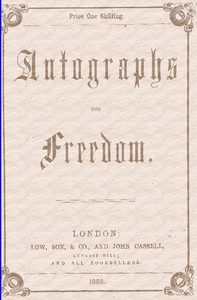
Autographs for Freedom, by Mrs. Harriet Beecher Stowe, and Thirty-five Other Eminent Writers Book Summary
Content: It contains essays, poems, letters, and resolutions penned by individuals like John Quincy Adams, William Lloyd Garrison, Frederick Douglass (whose essay is included here), Ralph Waldo Emerson, and, of course, Harriet Beecher Stowe herself. Contributors express outrage at the cruelty of slavery, debate its constitutional legitimacy, appeal to religious conscience, and assert the inherent equality of all people.
Purpose: Its primary purpose was to document the breadth and depth of opposition to slavery, lending moral weight and diverse perspectives to the abolitionist cause, and to appeal to a broad audience, including those sympathetic but needing further convincing.
1. The Power of Collective Voice and Diverse Perspectives: One of the most significant aspects of this book is how it demonstrates the abolitionist movement wasn't monolithic. It showcases a wide range of voices – legal minds, religious leaders, poets, politicians like John Quincy Adams who wrote from his prison cell, and passionate activists. This diversity strengthens the argument, showing that opposition to slavery came from many walks of life and was based on varied but converging moral, ethical, and intellectual grounds. It powerfully illustrates that the fight against slavery was seen as a universal moral imperative.
2. Moral Urgency and Divine Judgment: Many contributors frame the fight against slavery not just as a political or social issue, but as a moral imperative. They invoke religious texts and beliefs, arguing that slavery is a sin against God and humanity, a violation of natural rights, and a sign of the nation's moral decay. Harriet Beecher Stowe's contribution, drawing on her own powerful novel Uncle Tom's Cabin, emphasizes the humanity of the enslaved and the cruelty of their treatment, appealing directly to the reader's compassion and sense of justice. This moral urgency was a central driver of the abolitionist movement.
3. Linking Literature and Social Change: The inclusion of Harriet Beecher Stowe's essay is particularly telling. Her novel Uncle Tom's Cabin had already become a sensation and a catalyst for anti-slavery sentiment. Her contribution here further amplifies the emotional and moral impact of her fictional narrative, translating its power into more direct polemic. The book itself serves as an example of how literature could be mobilized to fuel social reform movements, giving a human face to the plight of enslaved individuals and galvanizing public opinion.
4. The Argument Against Compromise: Many essays forcefully argue against any form of compromise regarding slavery. They contend that concessions to the slaveholding states would only perpetuate the injustice and delay its inevitable demise. The contributors believed that immediate, uncompromising action was necessary, reflecting the growing tension and polarization within the nation during the antebellum years.
This book would be particularly fitting for:
- Individuals interested in the history of the abolitionist movement in the United States, especially the period leading up to the Civil War.
- Those studying 19th-century American literature, history, or social movements.
- Readers who want to understand the moral and intellectual arguments used to oppose slavery.
- People seeking primary source material on abolitionism, offering direct insights into the sentiments and rhetoric of that era.
- Anyone curious about the diverse figures and philosophies involved in the fight against slavery.
It might be less suitable for readers primarily interested in biographical details of a single author or the detailed plot of Uncle Tom's Cabin, as this is a collection of varied contributions. Furthermore, its dense and somewhat dated prose might require patience from readers unfamiliar with 19th-century language and abolitionist fervor.
Yes, Autographs for Freedom absolutely still matters today.
It provides invaluable historical context for understanding the roots of the American Civil War, the nature of systemic injustice, and the power of moral conviction in driving social change. Reading these essays helps us grasp the moral arguments that fueled one of the nation's most defining struggles. It reminds us that the fight for human rights and against oppression often requires immense courage, diverse perspectives, and unwavering moral clarity. The book forces us to confront uncomfortable truths about societal values and the historical precedents for mobilizing public opinion around ethical issues.
Suggested Next Book: The Fiery Trial: Abraham Lincoln and the American Civil War by Eric F. Johnson
Reason for Suggestion: While Autographs for Freedom sets the stage for the conflict by detailing the abolitionist drive, Johnson's book delves deeper into the political, military, and social dimensions of the Civil War itself, exploring Lincoln's leadership and the complex factors leading to the nation's division. It builds directly on the historical foundation laid by the abolitionist writings to provide a more comprehensive understanding of how the struggle for freedom culminated in that pivotal conflict.
| Reading on Gutenburg | Free reading |
| Get Paperback Version on Amazon | Buy a book |
| Suggest Book : The Fiery Trial: Abraham Lincoln and the American Civil War Book | Get on Amazon |
In conclusion, Autographs for Freedom is a crucial historical document that offers a compelling glimpse into the passionate and principled opposition to slavery in 19th-century America. It showcases the eloquence, moral courage, and collective determination of a diverse group of individuals fighting for what they believed was a just cause. Though written centuries ago, its exploration of fundamental questions of human rights, justice, and societal responsibility continues to resonate, reminding us of the enduring power of conviction and the ongoing importance of challenging injustice. Reading this collection provides a powerful historical lens through which to view America's past and its ongoing journey toward equality.