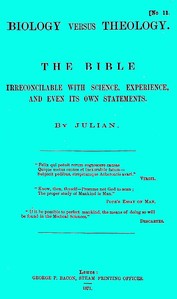
Biology versus Theology. The Bible: irreconcilable with Science, Experience, and even its own statements Book Summary
Key Lessons from the Book
The core message is a strong critique of biblical literalism in the face of modern science:
1. Literalism vs. Science: The author contends that scientific discoveries, particularly in biology (evolution) and earth sciences (geology, cosmology), directly contradict the literal interpretations of Genesis and other foundational biblical texts regarding the origins of life, the age of the Earth, and the structure of the natural world. For example, the book likely argues that the scientific evidence for common descent undermines the biblical account of distinct kinds created separately.
2. The Bible's Own Contradictions: A significant portion of the argument involves pointing out perceived inconsistencies and contradictions within the Bible's own accounts. By highlighting these, the author suggests that a commitment to literal truthfulness leads to internal logical problems, making the Bible an unreliable or incoherent source of absolute truth when taken word-for-word. This might involve comparing different creation accounts or prophetic fulfillments that don't align neatly.
3. Experience as a Standard: The book elevates empirical observation and human experience as superior guides to understanding reality compared to scriptural authority. It argues that insisting on a literal reading of the Bible leads to beliefs that are contrary to observable facts and rational thought, such as a geocentric universe or a young Earth. The author likely uses examples from everyday life or established scientific consensus to illustrate this point.
Is This Book Fit for You?
- If you are interested in the history of science-religion debates, especially the conflict around evolution and fundamentalism in the late 19th/early 20th century, this book offers a primary perspective.
- If you want insight into the arguments used by critics of biblical literalism during a specific historical period, this text provides that.
- If you are researching the development of scientific skepticism towards traditional religious interpretations, it serves as a relevant source.
- If you are looking for a balanced modern view on evolution and faith, this book is likely one-sided and dated.
- It is most suitable for readers with some background knowledge of the scientific context (evolution) and biblical texts.
Yes, this book still matters today, primarily as a historical document and a case study.
It represents a specific phase in the ongoing dialogue (or sometimes conflict) between scientific understanding and religious belief. Studying such arguments helps us understand the historical roots of current debates, the intellectual challenges faced by literalist interpretations, and the evolution of both scientific and theological responses. It provides context for how certain scientific ideas were integrated (or rejected) into religious frameworks.
However, the specific arguments and examples, while historically significant, might seem dated against the backdrop of modern scientific consensus and the diverse range of contemporary approaches to reconciling faith and science (e.g., theistic evolution, scientific creationism updated, etc.).
| Reading on Gutenburg | Free reading |
| Get Paperback Version on Amazon | Buy a book |
| Suggest Book : Where the Conflict Really Begins: Science and Religion Book | Get on Amazon |