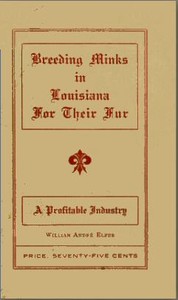
Breeding minks in Louisiana for their fur: A profitable industry Book Summary
The book, while a product of its specific historical and economic context, offers several points of interest and learning, even today:
1. Resourcefulness and Industrialization of Agriculture: It demonstrates how traditional farming practices could be adapted into specialized, high-value industries. The author emphasizes converting existing agricultural land and resources (like fencing materials) into a profitable mink farming operation, showcasing early forms of agricultural diversification and industrial thinking applied to farming.
2. The Economics of Specialized Livestock: The book delves into the financial calculations necessary for profitability – calculating initial investment costs (land, buildings, initial stock, equipment), expected production costs per mink, projected yields, and market prices. It highlights the need for careful accounting and efficiency to turn a modest investment into significant returns, a principle still relevant for any agricultural or business venture.
3. Practical Husbandry Techniques: It provides detailed instructions on mink biology relevant to farming (breeding cycles, molting), housing requirements (pen design, predator control), feeding regimes (diet composition, nutritional needs), and handling practices. While some specific advice might be outdated, the core principles of understanding animal needs for production, hygiene, and welfare are timeless aspects of animal husbandry.
4. Market Orientation: The book stresses the importance of understanding and accessing the global fur market. It addresses quality standards, grading of pelts, and the need to establish reliable connections with furriers and traders, illustrating how agricultural production is embedded within broader economic and international trade systems.
5. Regional Economic Development: It positions mink farming as a viable economic activity for rural Louisiana, suggesting how such industries could provide employment and diversify local economies. This reflects a common theme in industrialization literature – using specialized agriculture to build wealth in less developed regions.
You might find this book particularly fitting if you are interested in:
- The history of American agricultural development and industrialization.
- The specific history of Louisiana or the Southern United States economy.
- Historical perspectives on specialized animal farming or the fur trade.
- Early 20th-century business practices, entrepreneurship, and economic literature.
- The evolution of ideas about resource management and land use for profit.
- Understanding the context behind niche historical industries that may have since declined.
- Historical Context: Understanding the economic strategies and industrial ambitions of the early 20th century, particularly regarding land use and diversification.
- Animal Husbandry Evolution: Seeing the practical techniques and assumptions of the time regarding specialized livestock farming, which can inform discussions on the history and ethics of modern animal agriculture.
- Market Dynamics: Illustrating how niche industries operate and the importance of market access and quality standards, lessons applicable to any product-focused business today.
- The Rise and Fall of Industries: Studying why certain industries gain prominence and then decline, highlighting factors like market demand shifts, resource availability, and technological changes.
However, its specific practical advice on mink farming techniques may be less directly applicable due to changes in animal welfare standards, environmental regulations, consumer preferences (towards sustainable or synthetic alternatives), and market dynamics for fur.
| Reading on Gutenburg | Free reading |
| Get Paperback Version on Amazon | Buy a book |
| Suggest Book : The Jungle by Upton Sinclair Book | Get on Amazon |