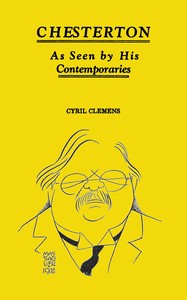
Chesterton, as seen by his contemporaries Book Summary
G.K. Chesterton: A Paradoxical Figure
G.K. Chesterton, a towering figure of the 20th century, remains a complex and often polarizing personality. Known for his prolific writings, including essays, novels, poems, and journalism, Chesterton was an irreverent wit, a dedicated Catholic convert, a socialist-turned-Therapist, and a champion of seemingly contradictory virtues. His contemporaries, who knew him personally and professionally, offered diverse and sometimes conflicting perspectives on his multifaceted character and immense influence in the collection 'Chesterton, as seen by his contemporaries'. This book gathers reflections from various writers, thinkers, and friends, providing a snapshot of the man and his impact during his lifetime.
A Collection of Contemporary Perspectives
This book is not a biography or a systematic analysis of Chesterton's works, but rather a compilation of essays, appreciations, and recollections written by people who knew him. Contributors include prominent literary figures like H.G. Wells, T.S. Eliot, Dorothy Sayers, and J.M. Barrie, among others. Each chapter offers a unique lens through which to view Chesterton, touching upon his writing style, his religious conversion, his political views (which often shifted), his humor, his paradoxical nature, and his unwavering individualism. It provides insights into his personality, his methods, and the impact he had on his peers.
Key Insights from 'Chesterton, as seen by his contemporaries'
1. The Enduring Power of Paradox: Chesterton was fascinated by apparent contradictions and paradoxes in life and logic. His contemporaries noted how he embraced these, often using them as the basis for his arguments and humor. For example, his concept of 'The Thing' (the idea that there might be a reason for a policy even if it seems irrational) exemplifies this. He saw complexity where others saw simplicity, challenging readers to think beyond black-and-white answers.
2. Wit as Weapon and Window: Chesterton's sharp, often irreverent wit was both a defense mechanism and a powerful tool for social and intellectual critique. His contemporaries admired his ability to expose hypocrisy and foolishness with brilliant satire, while also finding profound wisdom in his seemingly playful observations. His essays, for instance, used clever analogies and unexpected twists to make complex ideas accessible and to provoke thought.
3. The Transformative Power of Faith: His conversion to Catholicism was a central, often misunderstood, event in his life. Many contemporaries acknowledged its profound impact on his character and writing. They saw a transformation from a secular socialist towards a deeply devoted and intellectually rigorous Christian thinker. His essays and novels from this period engage deeply with Christian doctrine and its implications for society, demonstrating how faith reshaped his worldview.
4. Uncompromising Individualism: Chesterton was a champion of the individual against collectivism and conformity. His contemporaries recognized his fierce defense of personal liberty, even when it seemed unconventional or challenging to the establishment. He advocated for the 'decent eccentric' – the individual who stands for something, even if it's different. This individualism extended to his literary style, which was unique and resistant to prevailing trends.
5. The Joy of 'I Don't Know': Contrary to the assertion of omniscience, Chesterton often championed intellectual humility. He embraced mystery and acknowledged the limits of human knowledge, particularly in matters of faith. His contemporaries saw this not as a weakness, but as a strength and a necessary antidote to dogmatism, encouraging readers to remain open to the unexpected and the mysterious.
Who Should Read This Book?
- Fans of G.K. Chesterton seeking deeper insights into his character from those who knew him personally.
- Students of literature, cultural history, or 20th-century British intellectual life.
- Those interested in the dynamics of friendship, disagreement, and influence among writers and thinkers.
- Individuals curious about the diverse reactions and interpretations of a complex public figure.
- Readers who appreciate biographical collections and are fascinated by the 'making of' a significant cultural figure.
Enduring Relevance: Does the Book Still Matter?
Yes, 'Chesterton, as seen by his contemporaries' retains its relevance. Chesterton's exploration of paradox, his defense of individualism, his critique of conformity, and his grappling with faith and reason continue to resonate in our complex world. Our times, marked by rapid technological change, social fragmentation, ideological polarization, and a search for definitive answers, still find echoes in Chesterton's insistence on complexity, his appreciation for 'mere' things, and his call to resist the tyranny of the majority. The insights offered by his contemporaries into his thought process and the challenges he posed remain valuable for anyone seeking a deeper understanding of ideas and how they shape society.
| Reading on Gutenburg | Free reading |
| Get Paperback Version on Amazon | Buy a book |
| Suggest Book : The Family: A World History Book | Get on Amazon |
A Testament to a Remarkable Mind
In conclusion, 'Chesterton, as seen by his contemporaries' offers a rich tapestry of voices reflecting on a truly unique mind. It provides a valuable counterpoint to more formal biographies, capturing the immediacy and human dimension of G.K. Chesterton. The book underscores his enduring appeal as a writer, thinker, and cultural force, demonstrating why he continues to fascinate and challenge readers decades after his death. It is a testament to his impact on his time and, perhaps, to the timeless questions he engaged with.