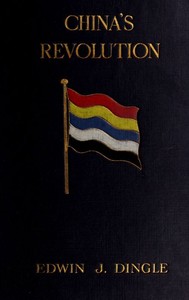
China's Revolution, 1911-1912: A Historical and Political Record of the Civil War Book Summary
"China's Revolution, 1911-1912: A Historical and Political Record of the Civil War" by Edward Harold Cox is a fascinating, if somewhat dryly presented, primary source account of the Xinhai Revolution – the uprising that overthrew the Qing Dynasty and established the Republic of China. Written in 1912, it provides a unique, immediate perspective on a pivotal moment in Chinese history, relying heavily on documents, proclamations, and reports from the period.
This book meticulously documents the events of the Chinese Revolution from its initial sparks in Wuchang in October 1911 to the establishment of the provisional government in Nanjing in February 1912. It’s not a narrative history in the traditional sense, but rather a compilation of official and semi-official materials – troop movements, decrees issued by revolutionary leaders, reports from foreign observers, and even correspondence. Cox aims to present a comprehensive, factual record of the revolution, focusing on the political and military aspects rather than deep dives into social or economic causes. The book details the rapid collapse of the Qing Dynasty, the rise of Sun Yat-sen as a revolutionary figure, and the complex negotiations that followed, including the abdication of the last emperor, Puyi.
One of the most striking lessons from the book is the fragility of imperial power in the face of widespread discontent and organizational weakness. The Qing Dynasty, despite centuries of rule, was remarkably vulnerable. Cox details how a relatively small number of revolutionaries, often poorly equipped, were able to trigger a cascade of uprisings across the provinces. This wasn’t due to overwhelming revolutionary strength, but rather the Qing army’s lack of loyalty, poor leadership, and the dynasty’s inability to effectively respond to the growing demands for political reform. The reliance on regional armies, often more concerned with their own power than with the central government, proved fatal.
Another key takeaway is the critical role of regionalism and the lack of a unified national identity in shaping the revolution’s course. China in 1911 wasn’t a cohesive nation-state; it was a collection of provinces with distinct interests and loyalties. Revolutionary movements often originated and gained traction in specific regions, like the south, and struggled to gain universal support. Warlordism, which would plague China for decades after the revolution, had its roots in this fragmented political landscape. The book highlights how different generals and provincial leaders often pursued their own agendas, making the establishment of a stable republic incredibly difficult.
The book also illustrates the importance of external factors and foreign involvement in Chinese affairs. European powers, Japan, and the United States all had significant economic and political interests in China, and their actions (or inaction) profoundly influenced the revolution. While foreign powers generally avoided direct military intervention on a large scale, they provided financial support to various factions and exerted diplomatic pressure to protect their interests. Cox emphasizes how these external pressures complicated the internal dynamics of the revolution and contributed to its messy and protracted outcome. The scramble for concessions and spheres of influence demonstrates a China unable to fully control its own destiny.
Finally, the book reveals the complex and often opportunistic nature of political leadership during times of upheaval. Figures like Yuan Shikai, who ultimately seized control of the republic, were willing to shift allegiances and compromise principles to advance their own power. Sun Yat-sen, while genuinely committed to republican ideals, faced constant challenges from rivals and lacked the military strength to enforce his vision. The revolution wasn’t a clear-cut triumph of democracy, but rather a power struggle between competing elites, each with their own ambitions and agendas. This highlights the difficulties of establishing a truly representative government in a context of weak institutions and deeply entrenched power structures.
This book is ideal for readers who:
- Have a strong interest in Chinese history, particularly the late Qing Dynasty and the early Republic.
- Prefer primary source material and a detailed, documentary-style approach to history.
- Are interested in the political and military aspects of revolutions.
- Want to understand the complex power dynamics that shaped modern China.
- Don’t mind a slightly dense and academic writing style.
It may *not* be the best choice for those looking for a fast-paced narrative or a broad overview of Chinese culture and society.
Yes, this book remains incredibly relevant today. Understanding the origins of the Republic of China, and the forces that undermined its early development, is crucial for understanding modern China's political landscape. The issues of national unity, regionalism, the role of the military, and foreign interference that were central to the 1911 Revolution continue to resonate in contemporary Chinese politics. The legacy of Yuan Shikai, and the subsequent period of warlordism, shaped the trajectory of the Chinese Communist Revolution. The book provides valuable context for understanding why China struggled to achieve political stability and economic development for much of the 20th century.
To further explore this period and its aftermath, the next book to read should be:
| Reading on Gutenburg | Free reading |
| Get Paperback Version on Amazon | Buy a book |
| Suggest Book : The Search for Modern China Book | Get on Amazon |
"China's Revolution, 1911-1912" is a valuable, though challenging, resource for anyone seeking a detailed understanding of this pivotal event. While it lacks the narrative flair of some modern histories, its reliance on primary sources offers a unique and insightful perspective on the birth of modern China. It’s a book that rewards careful reading and provides a solid foundation for further exploration of this complex and fascinating period.