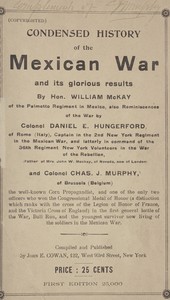
Condensed History of the Mexican War and Its Glorious Results Book Summary
Introduction
This summary covers 'A Condensed History of the Mexican War and Its Glorious Results,' a book published in 1848. The work presents a pro-American, anti-Mexican perspective on the Mexican-American War (1846-1848). It aims to glorify American military actions and justify the immense territorial gains the United States achieved, particularly in the Southwest.
What is this book about?
The book is a narrative history of the Mexican-American War, written from a distinctly American viewpoint. It emphasizes American military prowess, portrays Mexican leadership as incompetent or treacherous, and celebrates the democratic ideals supposedly advanced by the conquest. It argues that the war was necessary to secure American claims and destiny in North America, justifying the annexation of vast territories like California, New Mexico, and parts of Arizona and Utah. The tone is highly patriotic and supportive of the war effort.
Key Lessons
This book offers several key takeaways, though heavily influenced by its own time and perspective:
1. **The Power of Nationalist Narrative:** The book demonstrates how a conflict can be framed through a powerful, albeit biased, national narrative. It emphasizes American destiny, divine favor, and military heroism to rally support and justify conquest. It downplays or dismisses Mexican perspectives and motivations.
2. **The Role of Controversial Annexation:** It highlights the Texas annexation as a crucial catalyst for the war, framing it as a right and duty for the United States, despite the contentious nature of the issue and the disputed border (whether Texas ended at the Nueces or the Rio Grande). This underscores how territorial claims can ignite conflicts.
3. **Glorification of Military Action:** The text glorifies specific American victories, often attributing them to American ingenuity, discipline, and leadership while depicting Mexican forces as poorly equipped, poorly led, and motivated by cruelty or corruption. This reflects a common, albeit one-sided, way wars are remembered in the victor's history.
4. **The Consequences of Victory:** It details the terms of the Treaty of Guadalupe Hidalgo, presenting the acquisition of California and other territories as a glorious outcome, but without fully exploring the human cost or the impact on the Mexican people and their nation. The focus remains squarely on American gain.
5. **Manifest Destiny in Action:** The book serves as a prime example of the ideology of Manifest Destiny, where the expansion of the United States across the continent was seen as both inevitable and justified. The Mexican War is presented as a key step in fulfilling this destiny.
Is this book fit for me?
This book is particularly useful if you are:
- Studying the history of the Mexican-American War or 19th-century American expansion.
- Exploring how historical narratives are shaped by national pride and political agendas.
- Analyzing propaganda and bias in historical texts.
- Understanding the concept of 'Manifest Destiny' and its real-world consequences.
- Reading from a primary source perspective (though this one is already a secondary account published during the war's aftermath).
It may be less suitable if you seek a balanced, modern historical analysis or are looking for an objective account of the war's impact on Mexico.
Does it still matter today?
Yes, this book remains relevant for several reasons. It provides a window into the mindset driving 19th-century American expansionism, an ideology with echoes in contemporary geopolitical debates about national interest, interventionism, and territorial claims. It also serves as a case study in how wars are often sold to the public through patriotic narratives that can obscure complexities and consequences. Furthermore, understanding this conflict is crucial for comprehending the origins of the United States-Mexico border, the history of the American Southwest, and the legacy of indigenous and Latino populations in those regions. It highlights the long-term effects of conquest and the often-painful reinterpretations of history by the conquered nations.
**Therefore, for a more balanced and contemporary understanding of the Mexican-American War, I suggest reading:** "The Mexican War of Independence: A Revolution in Many Wars, 1810-1821" by John K. Montefiore.
| Reading on Gutenburg | Free reading |
| Get Paperback Version on Amazon | Buy a book |
| Suggest Book : The Mexican War of Independence: A Revolution in Many Wars, 1810-1821 Book | Get on Amazon |
Conclusion
In conclusion, 'A Condensed History of the Mexican War and Its Glorious Results' is a product of its time, offering a fervent and one-sided account of a pivotal conflict. While potentially useful for understanding 19th-century American nationalism and expansionism, it should be read critically and alongside more objective, modern historical analyses to gain a fuller and more balanced perspective on the Mexican-American War and its enduring significance in the history of the United States and Mexico.