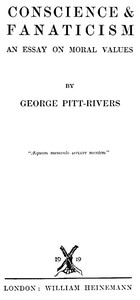
Conscience & Fanaticism: An Essay on Moral Values Book Summary
Introduction
This essay delves into the complex relationship between individual conscience and collective fanaticism. W.H. Auden, the renowned poet, philosopher, and critic, examines how seemingly reasonable moral beliefs can become distorted into rigid, dogmatic systems that lead to intolerance and violence. The book is less an academic treatise and more a profound reflection on the nature of belief, the dangers of absolutism, and the slippery slope from sincere conviction to dangerous fanaticism.
What is this book about?
"Conscience & Fanaticism" is an essay first published in 1955. Auden argues that fanaticism often arises not from pure evil, but from a misinterpretation or misapplication of deeply held moral values. He explores how certain individuals, feeling morally superior or burdened by a strong sense of duty, can twist their conscience into a tool for enforcing their specific worldview on others, often through coercive or intolerant means. The essay touches upon religious, political, and artistic fanaticism, analyzing their common characteristics and the psychological underpinnings that fuel them. It's a critical examination of the fine line between principled conviction and dangerous extremism.
Key Lessons
Defining Fanaticism: Auden doesn't simply condemn fanaticism outright. He seeks to define it, distinguishing between passionate conviction and fanaticism. Fanaticism, he suggests, involves an unwavering commitment to a set of beliefs that leaves no room for doubt, debate, or alternative perspectives. It becomes an end in itself, a system of thought that demands absolute adherence, often leading to the suppression of dissent or the application of rigid rules (moral or otherwise) to everyone, including those who disagree.
Conscience as a Compass or a Weapon: The core of the essay is the relationship between conscience and fanaticism. Auden posits that a healthy conscience serves as a guide for ethical conduct, rooted in empathy and a sense of shared humanity. However, a fanatic can weaponize their conscience, using it to justify intolerance and exclusion. They might interpret their conscience as granting them a special mission to 'correct' or 'save' others according to their own rigid interpretation of truth. For example, a religious fanatic might feel their conscience compels them to impose their beliefs on others through proselytizing or even violence, seeing dissent as a moral failing.
The Role of Language: Auden also analyzes how language can be used to foster fanaticism. Certain words and phrases acquire a sacred, unquestionable quality, becoming tools to shut down nuanced discussion. By defining complex issues in absolute terms and labeling dissenters as 'ungodly,' 'irresponsible,' or 'evil,' fanatics can create an atmosphere where compromise seems unthinkable and their own perspective is the only valid one.
Historical Examples: While not a primary focus, Auden draws implicitly on historical examples, suggesting how this dynamic has played out throughout history – from religious crusades to political purges. Fanaticism, in his view, is a recurring human tendency whenever strong moral or ideological feelings encounter a lack of tolerance for ambiguity.
Intellectual Honesty: Ultimately, Auden calls for intellectual honesty. He urges readers to examine their own beliefs, acknowledging the possibility of error and the danger of absolute certainty. Recognizing the potential for fanaticism within oneself or others is the first step towards preventing its destructive manifestations.
Is this book fit for me?
- Philosophy/Political Science/Religious Studies Students: You will find Auden's analysis of belief systems, fanaticism across different domains, and his critique of dogma intellectually stimulating.
- History Buffs: Understanding the recurring patterns of fanaticism in historical events can provide context for Auden's arguments.
- Critical Thinkers: If you are interested in the nature of belief, the limits of tolerance, and the dangers of ideological rigidity, this book offers valuable insights.
- Readers interested in W.H. Auden's works: It provides insight into his philosophical outlook and concerns.
- Those who have experienced or witnessed fanaticism: The book offers a framework for understanding and analyzing such experiences.
Does it still matter today?
Yes, absolutely. "Conscience & Fanaticism" remains profoundly relevant in our modern world. We continue to grapple with religious fundamentalism, political extremism (both left and right), ideological tribalism, and the use of 'moral absolutism' to justify policies or actions. Auden's insights into how belief systems can become rigid, how individuals can weaponize their conscience, and how language can be used to enforce conformity are timeless. Understanding these dynamics is crucial for navigating contemporary debates, promoting tolerance, and safeguarding democratic values against the allure of simplistic, absolute answers to complex questions.
| Reading on Gutenburg | Free reading |
| Get Paperback Version on Amazon | Buy a book |
| Suggest Book : The God Delusion Book | Get on Amazon |
Conclusion
"Conscience & Fanaticism" is a concise yet powerful essay by W.H. Auden that serves as a stark warning about the dangers of extreme belief systems. It challenges readers to examine the relationship between their own moral compass and the potential for intolerance it might harbor. While not a lengthy academic work, its clarity, historical perspective (though focused more on the mid-20th century context), and enduring themes make it a valuable read for anyone concerned with the nature of belief, the history of fanaticism, and the crucial importance of intellectual humility and tolerance in a pluralistic world. It remains a relevant and thought-provoking piece of writing. Tags : Philosophy & Ethics