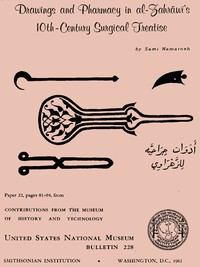
Drawings and Pharmacy in Al-Zahrawi's 10th-Century Surgical Treatise Book Summary
The book offers profound insights into the medical and surgical knowledge of the Islamic Golden Age:
Integration of Surgery and Pharmacy: Al-Zahrawi demonstrated an understanding that effective surgery requires not just cutting and healing, but also prophylaxis and treatment. He meticulously described how to prepare and use various medicinal compounds (ointments, powders, washes) to prevent infection and promote healing *after* surgery. This holistic view connected surgical intervention with pharmacological treatment, recognizing that healing is a process requiring multiple therapeutic approaches. For example, he detailed how to prepare antiseptic solutions from natural ingredients and how to use them post-operation.
Advancement in Surgical Techniques and Illustrations: The detailed illustrations in the 'Tasrif' are revolutionary. They show complex surgical procedures with remarkable anatomical accuracy for the time, including surgical instruments never seen before in European texts. These visuals served as a crucial teaching tool and surgical reference, demonstrating advanced techniques like wound debridement, fracture setting, tumor removal, and even rhinoplasty (nose reconstruction). The level of detail and the number of illustrations set a new standard and influenced surgical practice for centuries.
Practical Application and Hygiene Awareness: Moving beyond theoretical knowledge, Al-Zahrawi focused on practical application. He described surgical techniques clearly, often explaining variations and potential complications. Equally important was his emphasis on cleanliness and hygiene. He advocated washing wounds thoroughly and using antiseptic mixtures (like honey in vinegar), recognizing the importance of preventing putrefaction and gangrene, a concept that would only be fully rediscovered in the 19th century with antiseptic surgery. This practical, evidence-based (as much as possible within the limitations of the era) approach was highly influential.
Comprehensive Compilation of External Medicine: The 'Tasrif' was not just a surgical treatise but a comprehensive manual for practitioners dealing with trauma, infections, and external injuries. It covered a vast range of conditions and treatments, from treating burns and scorpion stings to dealing with leprosy, showing the breadth of medical knowledge available in Islamic centers of learning during the 10th century.
This book is ideal for:
- History enthusiasts, particularly those interested in the history of medicine, science, and technology.
- Students and scholars of Islamic history, medieval history, or the history of science.
- Medical professionals and historians of medicine seeking insights into the foundations of surgical practice and early pharmacology.
- Those interested in the history of illustration and its role in disseminating complex information.
- Readers curious about the cultural and intellectual achievements of the Islamic Golden Age.
It offers a direct window into the medical knowledge and practices of a significant historical period.
It provides invaluable primary source material for understanding the development of medical science. Al-Zahrawi's descriptions of surgical techniques, instruments, and procedures, along with his illustrations, are crucial for historians tracing the evolution of surgery and medicine. His practical emphasis on hygiene and wound care, though taken for granted today, was advanced for its time and shows the continuity of certain medical principles across millennia. The detailed pharmacological descriptions offer insights into early chemical and pharmaceutical practices. Furthermore, studying such texts highlights the global nature of scientific progress, challenging the narrative that Western medicine developed in isolation and showcasing the significant contributions made during the Islamic Golden Age.
| Reading on Gutenburg | Free reading |
| Get Paperback Version on Amazon | Buy a book |
| Suggest Book : The Family: A World History Book | Get on Amazon |