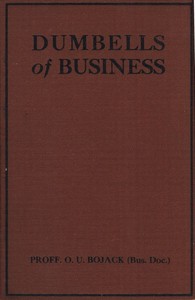
Dumbells of Business Book Summary
Introduction
"Dumbbells of Business" is a classic 1937 book by Russell Stetler that champions a balanced approach to business. The core message is simple yet profound: for a business to thrive, it must maintain a healthy equilibrium between its physical assets (like buildings, machinery, and raw materials) and its intangible assets (such as reputation, goodwill, and human capital). Stetler argues against the dangerous pendulum swings that prioritize either the physical side, leading to neglect of relationships and ethics, or the intangible side, leading to operational weakness and lack of substance.
What is this book about?
"Dumbbells of Business" uses the analogy of the weightlifting dumbbell, with two equal and essential weights. Stetler applies this metaphor to business, suggesting that a company needs strong 'physical weights' (tangible operations, efficiency, resources) and equally strong 'intangible weights' (customer trust, employee morale, ethical practices, reputation). The book warns against businesses that become overly focused on one side, leading to failure. It emphasizes the importance of building and maintaining both the 'hard' and 'soft' aspects of a business simultaneously. Stetler draws from his own experiences and observations of business failures and successes to illustrate his points.
Key Lessons
The Balance is Crucial: Stetler's central argument is that success comes from balancing physical and human/ethical factors. He uses the analogy of the dumbbell: if one side is neglected, the whole system becomes unbalanced and unstable. For example, a factory might produce efficiently (physical side) but if it treats its workers poorly, harms its reputation (intangible side), leading to loss of skilled labor and customer distrust.
Goodwill and Reputation are Tangible Assets: Stetler argues that a company's reputation, built through honest dealings, quality products, and fair treatment of employees and customers, is far more valuable and lasting than any physical asset. This 'goodwill' can be the difference between mere survival and true prosperity. A company might invest heavily in new machinery but lose customers and partners due to a single scandal, demonstrating the fragility and value of the intangible side.
Leadership and Morale Drive Performance: Stetler emphasizes that the 'human element' within the intangible dumbbell includes not just reputation but also the morale and skills of the workforce. He argues that motivated, fairly treated employees are more productive and innovative than simply relying on expensive machines. A business that neglects its employees' well-being risks high turnover, low productivity, and ultimately, failure, regardless of its physical capabilities.
Profit is the Goal but Not the Sole Measure: While profit is acknowledged as necessary for survival and growth, Stetler suggests it should not be the only focus. Long-term success requires building a sustainable business foundation that includes ethical practices and strong relationships, which contribute to sustained profitability. Short-term gains achieved by cutting corners on the intangible side (e.g., sacrificing quality or ethics) are often short-lived.
Is this book fit for me?
- If you are an entrepreneur or small business owner looking for foundational principles.
- If you appreciate timeless business wisdom and analogies.
- If you are interested in the balance between operational efficiency and people/ethics.
- If you want insights into why businesses succeed or fail based on internal and external perceptions.
- Readers interested in personal development related to business thinking.
This book is particularly useful for those seeking a primer on business philosophy or looking for a reminder of the fundamental balance required for sustainable success.
Does it still matter today?
Yes, absolutely. "Dumbbells of Business" offers principles that remain highly relevant in the modern business landscape. Today's complex issues like corporate scandals, focus on 'soft skills' in management, the rise of brand reputation as a key asset, and the importance of company culture all echo Stetler's core message. The book serves as a timeless reminder that building a successful business isn't just about technology, automation, or market share, but fundamentally about integrating tangible operations with intangible value – trust, people, ethics, and reputation. It challenges the common modern focus on purely quantitative metrics and reminds us of the qualitative aspects that underpin long-term success.
| Reading on Gutenburg | Free reading |
| Get Paperback Version on Amazon | Buy a book |
| Suggest Book : The Psychology of Money Book | Get on Amazon |
Conclusion
"Dumbbells of Business" provides a simple yet powerful framework for understanding business success. Its core message – the necessity of balancing physical and intangible assets – remains a valuable guide for anyone involved in commerce, whether starting a small venture or managing a large corporation. While written decades ago, its wisdom transcends time and technology, focusing on enduring human and ethical principles. It encourages readers to look beyond short-term gains and consider the holistic balance required for sustainable prosperity. For those seeking complementary modern insights into financial behavior and decision-making, "The Psychology of Money" offers a highly recommended perspective. Tags : Business/Management Culture/Civilization/Society