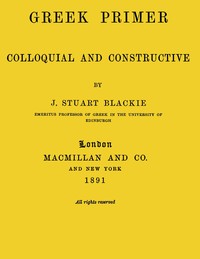
Greek primer, colloquial and constructive Book Summary
Ancient Greek Primer
This summary explores the content, pedagogical approach, and enduring value of "Greek Primer: Colloquial and Constructive" by John H. Arnold, a foundational text for learning Ancient Greek. Originally published in 1939, it represents an early modern approach to teaching the language, focusing on practical usage alongside grammatical structure.
Book Overview
"Greek Primer: Colloquial and Constructive" is a classic, early 20th-century textbook designed to introduce beginners to the language, grammar, and literature of Ancient Greece. The author, John H. Arnold, aimed to present Greek not just as a dead language, but as a living one, essential for understanding Western civilization's roots. The book's title itself highlights its dual focus: "Colloquial" emphasizes everyday speech and practical communication, while "Constructive" refers to its systematic, step-by-step approach to building language skills through grammar and composition. It is targeted at students with little to no prior Greek, likely preparing them for further study of classical literature, history, and philosophy.
Key Pedagogical Lessons and Approach
The book's enduring pedagogical value lies in its methodical and practical approach. Arnold believed in immersing students in the language from the very beginning. One major lesson is the emphasis on core vocabulary. The primer starts with essential words and phrases, enabling immediate, limited communication ('colloquial') before tackling complex grammar. It includes dialogues and simple narratives, often adapted from classical sources but simplified for learners, illustrating vocabulary in context.
Another crucial lesson is the integration of grammar. Grammar is not presented as a separate, abstract set of rules, but as a tool to be discovered through language use. Lessons systematically introduce concepts like noun cases (nominative, genitive, dative, accusative), verb tenses and moods (indicative, subjunctive, optative), and sentence structure. The 'constructive' aspect likely involves exercises that guide students in building their own simple sentences, reinforcing the grammatical points introduced in the explanations.
The book also teaches the importance of reading authentic texts. After building foundational skills, it introduces selections from Greek literature, first with vocabulary help and then independently, bridging the gap between textbook exercises and genuine classical texts. Furthermore, it underscores the necessity of active practice: memorization, translation, and composition are all stressed as essential components of learning Greek. This comprehensive approach aimed to equip students not only to understand Greek but also to express themselves in it.
Who Might Find This Book Useful?
This book is primarily suited for absolute beginners in Ancient Greek. If you are starting from scratch and seeking a structured, systematic introduction, it offers a clear path. It is particularly valuable for someone interested in the historical development of language teaching methods or for those seeking a foundational text that influenced later pedagogy. Its 'colloquial' focus makes it potentially appealing to those wanting to understand basic Greek for travel, simple texts, or a deeper appreciation of its structure. However, its age (published in 1939) means the language used in the text itself and some teaching assumptions may feel dated to modern readers accustomed to contemporary textbooks. It assumes a certain level of self-discipline required for tackling a lengthy primer without the multimedia resources common today.
Enduring Relevance
Yes, absolutely. Studying Ancient Greek remains highly relevant today. It provides direct access to the foundational texts of Western civilization: Homer's epics, the plays of Aeschylus, Sophocles, Euripides, the philosophical works of Plato and Aristotle, the histories of Herodotus and Thucydides, and foundational medical texts like Hippocrates. Understanding Greek allows one to engage with these primary sources directly, gaining invaluable insights into the culture, ideas, and intellectual history that shaped the modern world. It deepens understanding of English vocabulary (as many English words and roots come from Greek) and enriches the reader's grasp of logic, rhetoric, and political thought.
Moreover, learning an ancient language offers cognitive benefits, such as improved memory, analytical skills, and understanding of language structure in general. The skills developed in mastering Greek—parsing, analyzing syntax, recognizing roots, and understanding historical context—are transferable to the study of other languages and complex texts. Therefore, the fundamental goal of this primer—to equip learners to engage with the source material—is still a crucial one for scholars, students, and anyone seeking a deeper connection to our cultural heritage.
| Reading on Gutenburg | Free reading |
| Get Paperback Version on Amazon | Buy a book |
| Suggest Book : Greek Beyond the Basics: An Intermediate Course Book | Get on Amazon |
Conclusion
"Greek Primer: Colloquial and Constructive" is a significant historical artifact in the field of language education. While its style and some pedagogical assumptions may differ from modern textbooks, its core principles of systematic grammar instruction combined with practical vocabulary and early exposure to reading remain sound. It serves as an excellent starting point for absolute beginners seeking a structured path into the language. The enduring importance of Ancient Greek underscores the continued value of such primers. While this primer is foundational, as one progresses, a more contemporary intermediate textbook like "Greek Beyond the Basics: An Intermediate Course" would likely offer updated exercises, broader text selections, and more nuanced explanations suited for advanced learners, building upon the foundation laid by Arnold's primer.