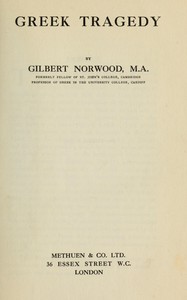
Greek tragedy Book Summary
Introduction
This book, titled "Greek Tragedy," is an anthology that compiles some of the most significant works from ancient Greek drama. It serves as an introduction to the genre, showcasing plays by master tragedians like Aeschylus, Sophocles, and Euripides. The collection provides readers with a foundational understanding of Greek tragedy's themes, structure, and historical context, offering a window into the ancient Greek worldview and their exploration of human suffering, fate, and morality.
What is this book about?
The book 'Greek Tragedy' gathers together some of the classic plays written during the golden age of Athenian drama. It primarily focuses on the works of three major playwrights: Aeschylus, known for his 'Oresteia' trilogy including 'Agamemnon' and 'The Libation Bearers'; Sophocles, famous for plays like 'Oedipus Rex' and 'Antigone'; and Euripides, whose works such as 'Medea' and 'The Bacchae' are included. The book aims to present these plays in a way that highlights their enduring power and significance, often providing introductory notes or commentary to help modern readers appreciate the cultural and historical background.
Key Lessons
Greek tragedy explores the fundamental struggles humans face against forces beyond their control. The most prominent theme is the conflict between human free will and divine or cosmic order. Characters like Oedipus, unknowingly defying fate, or Prometheus, challenging the gods, illustrate this struggle. Their tragic flaws, often called hamartia (a 'mistake' or 'tragic flaw'), lead them directly into misfortune. Oedipus's pride prevents him from recognizing his true lineage, while his relentless pursuit of truth ultimately destroys him. This teaches us that ignorance can sometimes be protective, but unchecked ambition and the refusal to accept one's limits can lead to downfall.
Another crucial lesson concerns the concept of hubris, or excessive pride/arrogance. Characters who believe themselves superior to the gods or who misuse their power invariably face severe consequences. This reflects an ancient understanding of the dangers of arrogance and the importance of recognizing human limitations. Furthermore, Greek tragedies often examine the complexities of morality in a world where actions have far-reaching, sometimes unintended, consequences. Characters must navigate between personal desires, societal laws, and divine decrees, forcing readers to consider difficult ethical questions about justice, sacrifice, and the nature of good and evil.
Finally, the plays frequently highlight the power of fate versus individual agency. The idea of 'moira' (fate or destiny) is pervasive. While characters often strive for control, their efforts are frequently thwarted by predetermined events. This exploration raises questions about the extent to which our lives are predetermined and the impact of our choices when faced with unavoidable outcomes. The catharsis, or purgation of pity and fear, experienced by the audience underscores the emotional and intellectual impact of these explorations, reminding us of our shared vulnerability and the importance of reflection on human conditions.
Is this book fit for me?
If you are interested in ancient history, classical literature, or the origins of dramatic storytelling, this book is likely suitable for you. It provides foundational knowledge for understanding the roots of theatre and dramatic structure. If you are a student of classics, philosophy, or literature seeking to explore the central themes of human suffering, morality, and the relationship between individuals and larger powers (divine or societal), this book offers essential material. However, if you are looking for a light, contemporary read or prefer modern psychological thrillers or detective fiction, this collection might be too dense or slow-paced. Furthermore, if you are completely unfamiliar with Greek mythology or ancient Greek culture, you might need supplementary reading to fully appreciate the context of the plays.
Does it still matter today?
Absolutely. The themes explored in Greek tragedy are timeless and profoundly relevant. The struggle between fate and free will, the dangers of unchecked power and pride, the consequences of moral dilemmas, and the pain of human loss and suffering are as pertinent now as they were in ancient Greece. Modern discussions about justice, ethics, political power, and personal responsibility often echo the questions posed by these plays. Understanding the origins of these universal themes through their exploration in Greek tragedy provides valuable context for contemporary issues and enriches our understanding of human nature and society.
| Reading on Gutenburg | Free reading |
| Get Paperback Version on Amazon | Buy a book |
| Suggest Book : Crime and Punishment Book | Get on Amazon |
Conclusion
In conclusion, the book 'Greek Tragedy' offers a compelling journey into the heart of ancient Athenian culture and drama. By presenting key works from Aeschylus, Sophocles, and Euripides, it illuminates profound themes that continue to resonate with readers today. While not a single cohesive narrative, the collection provides a vital introduction to a foundational literary and theatrical tradition. It challenges readers to confront deep questions about human nature, morality, and our place in the universe, demonstrating the enduring power of storytelling to explore the complexities of the human condition. For those moved by these themes, exploring works of modern literature that grapple with similar psychological and moral complexities, such as 'Crime and Punishment', can offer a fascinating contrast and further exploration of the human psyche under pressure.