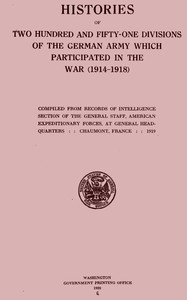
Histories of two hundred and fifty-one divisions of the German army which participated in the war (1914-1918) Book Summary
Introduction
This monumental work, compiled from official records and historical research, stands as a testament to the sheer scale of military organization during the First World War. It meticulously documents the history, battles, and fates of 251 distinct divisions that formed the backbone of the German Army on the Western Front. Imagine a single-volume repository capturing the journey of hundreds of thousands of soldiers across the brutal conflict.
What is this book about?
The book is an exhaustive compilation of historical data for 251 German army divisions involved in World War I. It primarily focuses on:
- Statistical Record: It details the establishment, composition (including nationality), strength, and deployment dates of each division.
- Battle Participation: It lists the major battles and campaigns in which each division took part, often noting their specific sector of the front.
- Mobilization and Fate: It covers the process of mobilization at the start of the war and the division's status at its conclusion (e.g., disbanded, transferred, lost, etc.).
- Historical Context: While primarily a catalog, the sheer volume of information provides invaluable context for understanding the German Army's structure, operations, and the immense human cost across the Western Front.
Key Lessons
This book, despite its seemingly dry format as a massive catalog, offers profound insights into the nature of industrial warfare and historical documentation:
1. The Scale of Modern Warfare: The sheer number of divisions (251) highlights the industrial scale of WWI. Nations mobilized vast reserves, indicating a shift from reliance on professional armies to mass conscription and total war. This wasn't just about a few elite units; millions of men were organized into countless formations, each contributing to the grinding war effort.
2. Comprehensive Documentation as Historical Memory: While not an engaging narrative, the book represents an attempt by the German military authorities to systematically record the participation of every major formation. This reflects an institutional effort to preserve history, albeit through statistics and official channels, rather than personal accounts. It's a valuable primary source for historians but lacks the human element found in memoirs or diaries.
3. Patterns and Anonymity: For the average reader, the book reveals patterns: which divisions were formed, their likely assignments, and common fates. However, it also underscores the anonymity of the soldier. While acknowledging their existence through the division count, the focus on the unit itself can obscure the individual stories within. It forces us to consider how history is often recorded and what gets lost in large-scale conflicts.
4. The Mechanics of War: By detailing mobilization dates, deployment sequences, and participation in specific battles, the book illuminates the logistical and administrative machinery behind warfare. Understanding which divisions fought when and where provides crucial context for analyzing tactical and strategic decisions on the Western Front.
Is this book fit for me?
If you are interested in the specific history of German military units during WWI, particularly their organizational details and participation, this book is invaluable. It is particularly useful for:
- Military historians and researchers focusing on WWI structure and operations.
- Those writing detailed accounts of specific battles or sectors of the front, needing to identify participating divisions.
- Genealogists tracing ancestors who served in specific German units.
- Students of military history seeking raw data on army composition.
However, if you are looking for an engaging narrative, analysis of strategy, or a deep dive into the human experience of the war, this book may not be the best fit due to its encyclopedic and statistical nature.
Does it still matter today?
Yes, this book remains relevant in several ways:
1. Understanding Historical Documentation: It serves as a case study in how large institutions (like armies) attempt to document their past, highlighting both the value and limitations of official records. It prompts questions about how history is preserved and who controls those records.
2. Lessons for Modern Conflict Analysis: The methods used to track and record division movements and battles can inform modern techniques for analyzing large-scale conflicts, even with digital tools. The sheer scale documented here is still relevant when considering modern wars involving massive troop movements.
3. Military History and Memory: Understanding the minutiae of WWI helps maintain the connection to our contemporary world shaped by that conflict. It reminds us of the organized, industrial nature of modern warfare and the importance of remembering the collective experience, even in anonymized form.
4. Educational Tool: For students and researchers, it remains a foundational reference for specific unit histories, enabling more nuanced understanding of broader historical narratives.
| Reading on Gutenburg | Free reading |
| Get Paperback Version on Amazon | Buy a book |
| Suggest Book : <div class="container"><div class="card"><div class="card-body"><h5 class="card-title">Suggest Book</h5><p>The book "Does the New Testament Know Its Own Gospel?" by Andreas Weigelt.</p></div></div></div> Book | Get on Amazon |
Conclusion
In conclusion, 'Histories of two hundred and fifty-one divisions' is a monumental, albeit impersonal, work. It doesn't offer the dramatic storytelling of a novel or the insightful analysis of a strategic history. Yet, it provides an unparalleled statistical snapshot of the German Army's machine on the Western Front during WWI. Its enduring value lies in its detailed cataloging, which is crucial for serious military historians, researchers, and genealogists, serving as a foundational reference for understanding the scale, organization, and sheer volume of the conflict from a specific national perspective. It reminds us that history, even in its most bureaucratic form, holds significant meaning.