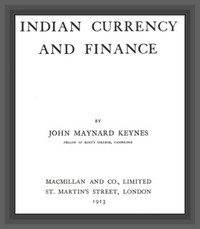
Indian Currency and Finance Book Summary
The Importance of Currency Stability: Keynes stresses the critical link between a stable currency and economic prosperity. India's reliance on silver, and the fluctuations in its value relative to gold (and thus the British pound), created significant uncertainty for trade and investment. He argued that a more stable exchange rate was essential for encouraging both domestic economic activity and international commerce. This wasn’t just about theoretical economics; it directly impacted the ability of Indian farmers to sell their goods in global markets and the cost of imports.
The Interconnectedness of Fiscal and Monetary Policy: A key theme is that monetary policy (managing the currency) cannot function effectively in isolation from fiscal policy (government spending and taxation). Keynes points out that the British government’s policies, like maintaining a rigid exchange rate, often clashed with the needs of the Indian economy. He criticizes the heavy reliance on land revenue as a source of government income, arguing it placed undue hardship on the agricultural sector and made the economy vulnerable to famines. He demonstrates how the opium tax, while generating revenue, had detrimental social and economic consequences, illustrating the moral hazards of prioritizing fiscal gains over societal well-being.
The Role of Government in Famine Relief: The book contains a powerful critique of the British administration’s response to famines in India. Keynes argues that a more proactive and robust government intervention, including the creation of reserves and efficient distribution networks, could have significantly mitigated the suffering. He specifically condemns the adherence to laissez-faire principles during times of crisis, which he believed exacerbated the impact of famines. He champions a system where the government actively manages resources to ensure food security, a concept that resonates strongly even today.
Understanding Colonial Economic Structures: Though Keynes doesn’t explicitly frame it as such, the book reveals the inherent imbalances in the colonial economic relationship. India was often treated as a source of revenue and raw materials for Britain, rather than as a fully developed economy in its own right. The monetary policies were often designed to benefit British interests, even if they were detrimental to Indian economic growth. Reading this work provides a crucial historical perspective on the lasting economic effects of colonialism.
- History Buffs: If you're interested in the economic history of India, particularly during the British Raj, this book is invaluable.
- Economics Students: It offers a unique perspective on early 20th-century economic thought and the practical application of economic principles.
- Political Science/Postcolonial Studies Readers: The book provides a window into the power dynamics of colonialism and the economic justifications for imperial rule.
- Those interested in Keynes's intellectual development: It's fascinating to see the foundations of his later work in this early analysis.
| Reading on Gutenburg | Free reading |
| Get Paperback Version on Amazon | Buy a book |
| Suggest Book : Poor Economics Book | Get on Amazon |