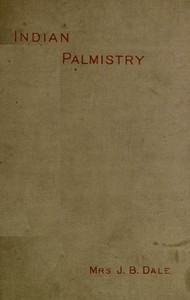
Indian Palmistry Book Summary
Introduction to Indian Palmistry
Welcome to a summary of 'Indian Palmistry,' a classic text exploring the ancient practice of reading the lines and mounts on the human hand. This book delves into the cultural and philosophical roots of palmistry within India, connecting hand features to personality traits, destiny, and spiritual insights. It's an exploration of how the lines on your palm might reflect aspects of your character, potential life paths, and connections to cosmic energies, presented through the lens of Indian spiritual traditions.
What This Book Is About
Published in 1934, 'Indian Palmistry' by Pandit Ramakrishna Tirtha (a renowned spiritual teacher and mathematician) is a foundational work in the field. It moves beyond mere fortune-telling to present palmistry as a system of self-knowledge and spiritual guidance deeply integrated with Indian philosophy, particularly Vedanta and Yoga. The book systematically describes the major lines (like the Life Line, Mind Line, Heart Line) and the significant mounts (the shapes and patterns of the mounts of Mercury, Venus, Sun, Moon, etc.) on the palm, detailing their meanings, variations, and how they interrelate. It aims to empower the reader to understand themselves and others through the study of the palm, viewing it as a microcosm reflecting the individual's journey and potential.
Key Lessons and Concepts
The book introduces several core concepts. Firstly, it presents the palm as a 'map' of the soul, where lines and mounts represent different facets of human existence. For instance, the Life Line is traditionally interpreted not just as a measure of physical vitality, but as indicating the inherent potential for action and the scope of one's life journey. Secondly, it emphasizes the importance of the mounts, particularly Mercury and Venus, which are considered the most influential planetary indicators. The shape, height, and condition of these mounts are said to reveal significant aspects of one's temperament, mental faculties, and overall vitality.
Thirdly, the book teaches the concept of 'Dharmic Lines,' suggesting that certain life lines (like the Career or Marriage line) can indicate one's fundamental life purpose or dharma according to their nature. Fourthly, it discusses the relative importance of fingers, suggesting that certain lines or mounts on specific fingers (like the thumb for Mercury) carry special significance. Finally, the book stresses the need for accurate interpretation, considering factors like the time of birth, handedness, and the overall configuration of the palm, rather than reading lines in isolation. It encourages a holistic, philosophical approach to understanding the patterns observed.
Is This Book Fit For Me?
This book is ideal for those interested in:
- Ancient Indian spiritual and philosophical traditions.
- The history and cultural context of palmistry.
- A foundational, systematic introduction to palm reading concepts.
- Self-reflection and using palmistry as a tool for personal insight.
- Comparing traditional palmistry practices with other systems.
It may be less suitable if you are looking for purely modern, scientific validation of palmistry or if you prefer contemporary or purely Western interpretations of hand reading.
Does It Still Matter Today?
Yes, absolutely. While the specific interpretations might be debated by modern scientists, the underlying human desire for self-knowledge, understanding personality through observation, and seeking meaning in patterns remains constant. 'Indian Palmistry' offers a unique window into an ancient philosophical framework that connects the microcosm (the hand) to the macrocosm (destiny and dharma). It provides historical context, foundational concepts, and a perspective that differs significantly from purely fortune-telling or Western astrological approaches. It remains relevant for those studying comparative spirituality, anthropology, or simply curious about different cultural approaches to understanding human nature.
Therefore, interested readers might next explore:
"Hands: The Story of the Human Body" by Frank H. Netter
This book provides a scientific, anatomical, and evolutionary perspective on the human hand. Reading it alongside 'Indian Palmistry' can offer a fascinating contrast, exploring the same physical object from a purely biological standpoint versus a philosophical and metaphysical one.
| Reading on Gutenburg | Free reading |
| Get Paperback Version on Amazon | Buy a book |
| Suggest Book : Hands: The Story of the Human Body Book | Get on Amazon |
Conclusion
'Indian Palmistry' by Pandit Ramakrishna Tirtha is a significant historical and philosophical text. It offers a deep dive into the principles and interpretations of palm reading within the rich context of Indian spiritual thought. While not a modern scientific manual, it serves as an excellent introduction to the cultural roots and interpretive frameworks of palmistry. It provides valuable historical perspective and foundational ideas for anyone interested in the practice, its history, or the intersection of spirituality and self-knowledge. Its enduring value lies in its exploration of perennial human concerns through an ancient and distinctive lens.