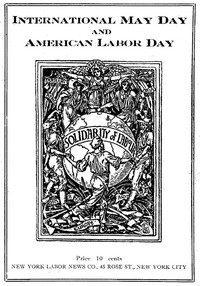
International May Day and American Labor Day A Holiday Expressing Working Class Emancipation Versus a Holiday Exalting Labor's Chains Book Summary
Published in 1901, 'International May Day and American Labor Day' by J.P. McDonnell is a fascinating historical document that dissects the origins and meanings of two prominent labor holidays. It’s not just a recounting of dates and events; it’s a pointed critique of the American labor movement’s trajectory and a passionate defense of the international socialist perspective embodied by May Day.
The book contrasts the International Workers' Day, celebrated on May 1st, with the American Labor Day, observed in September. McDonnell argues that May Day, born from the struggle for the eight-hour workday and rooted in socialist principles, genuinely represents working-class emancipation. Conversely, he contends that American Labor Day, established by a government often hostile to labor rights, serves more as a symbolic pacification – an ‘exaltation of labor’s chains’ – than a true celebration of worker achievement. He details the history of both holidays, focusing on the events leading up to their creation, the ideologies that shaped them, and the differing approaches to labor organization they reflect. It’s a deeply political work, advocating for a radical restructuring of society to benefit the working class.
One of the most crucial lessons from McDonnell’s work is the importance of understanding the political context in which holidays and traditions are created. He meticulously demonstrates how American Labor Day was deliberately crafted by elites to co-opt the labor movement and divert attention from more fundamental demands for systemic change. The holiday, with its parades and picnics, provided a safe, state-sanctioned outlet for worker expression, while avoiding the more challenging, potentially revolutionary goals associated with May Day. This isn't simply about two different dates; it's about two fundamentally different philosophies of labor and society.
Another key takeaway is the book’s exploration of the limitations of ‘pure and simple’ unionism. McDonnell wasn’t against trade unions, but he believed that focusing solely on wages and working conditions, without addressing the underlying power structures of capitalism, was ultimately insufficient. He saw the American Federation of Labor’s (AFL) emphasis on craft unionism and its political conservatism as hindering the broader struggle for working-class liberation. May Day, in his view, represented a more holistic approach, linking economic demands to broader political and social goals like socialism and international solidarity. For example, the Haymarket Affair, a pivotal event leading to May Day, wasn't just about an eight-hour workday; it was about challenging the very foundations of a system that exploited workers.
The book also vividly illustrates the power of internationalism in the labor movement. McDonnell highlights how May Day originated as a globally coordinated effort to demand the eight-hour workday, drawing inspiration and support from workers across borders. He contrasts this with the more nationally focused and often fragmented nature of the American labor movement at the time. The success of May Day, he argues, lay in its ability to unite workers around a common cause, transcending national boundaries and demonstrating the collective power of the international proletariat. This lesson resonates even today, as labor struggles increasingly involve global supply chains and interconnected economies.
Finally, McDonnell’s work underscores the importance of historical memory and the need to critically examine the narratives we are told about our past. He challenges the dominant American narrative of Labor Day as a simple celebration of worker achievement, revealing its more complex and often contradictory origins. By uncovering the hidden political agendas behind seemingly benign traditions, he encourages readers to question authority and to actively participate in shaping a more just and equitable future. It's a reminder that holidays aren't neutral; they are imbued with meaning and reflect the power dynamics of the societies in which they are celebrated.
This book is perfect for:
- Labor historians: It offers a valuable primary source perspective on the early labor movement.
- Political activists: It provides insight into the strategies and debates surrounding labor organizing.
- Those interested in the history of holidays: It offers a unique and critical look at the origins of Labor Day and May Day.
- Readers curious about socialism: It presents a clear articulation of socialist principles in the context of the labor struggle.
- Anyone who wants to understand the complexities of American labor relations.
Absolutely. While the specific context of 1901 has changed, the core issues McDonnell raises – the co-option of labor movements, the limitations of purely economic demands, the importance of international solidarity, and the need for critical historical analysis – remain incredibly relevant. We still see attempts to pacify worker discontent with symbolic gestures, the ongoing debate about the role of unions in broader social change, and the challenges of organizing labor across national borders. The rise of precarious work, the gig economy, and global supply chains only amplify these concerns.
Next book to read: Blood, Sweat, and Tears: Labor in the United States Since 1900 by Rick Fantasia and Kim Voss. This book builds on McDonnell’s analysis by providing a comprehensive overview of the American labor movement throughout the 20th and 21st centuries, showing how the struggles and debates he identified continued to evolve and shape the landscape of work.
| Reading on Gutenburg | Free reading |
| Get Paperback Version on Amazon | Buy a book |
| Suggest Book : Blood, Sweat, and Tears: Labor in the United States Since 1900 Book | Get on Amazon |
'International May Day and American Labor Day' is a powerful and thought-provoking book that offers a unique perspective on the history of labor and the enduring challenges of working-class liberation. It’s a reminder that the fight for economic justice is not just about better wages and working conditions; it’s about challenging the fundamental structures of power that perpetuate inequality. Though written over a century ago, its lessons continue to resonate with contemporary struggles for a more just and equitable world.