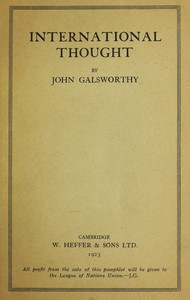
International Thought Book Summary
A Pioneering Work in International Thought
Published in 1926, International Thought by William Edward Dodd stands as a significant early attempt to systematically analyze and organize the burgeoning field of international relations at the dawn of the modern era, just after World War I. This book represents a foundational text, capturing the intellectual ferment and attempts to move beyond the failures of nationalism and isolationism that had led to the devastating conflict. Dodd, an academic and expert in international law, brings a unique perspective, blending legal, historical, and sociological analysis to explore how nations think about and interact with each other on the global stage.
Emerging from the Ashes of War
The book was written in the aftermath of World War I, a time when the international community was grappling with the immense destruction and seeking ways to prevent future conflicts. It examines the various intellectual currents shaping international affairs during this period. Dodd investigates the concepts, ideas, and frameworks—what he calls 'thought'—that underpin international relations. He looks at how nations perceive each other, the philosophical and practical bases for international law and cooperation, and the tensions between national sovereignty and collective security. The book is less about specific political actors or detailed diplomatic history, and more about the underlying intellectual landscape that shaped international politics in the 1920s, including the League of Nations era.
Key Insights and Ideas
1. The Primacy of Intellectual Frameworks: Dodd argues that international relations are fundamentally shaped by the intellectual frameworks, or 'thoughts,' that guide statesmen and nations. He examines concepts like realism (focused on power and security), idealism (focused on international law, cooperation, and morality), and others. For instance, he analyzes the rise of nationalism as a powerful force but also critiques its potential destructiveness, contrasting it with older cosmopolitan ideas. Understanding these currents is crucial to understanding foreign policy.
2. The Role of International Law and Institutions: A central theme is the potential and limitations of international law and institutions like the League of Nations as tools for managing state relations. Dodd explores how legal frameworks attempt to codify norms of behavior, arbitrate disputes, and enforce collective security, but he is also critical of their effectiveness in practice, given the conflicting national interests and the sovereignty of nation-states. He delves into specific issues like treaties, alliances, and diplomatic protocols.
3. Bridging Nationalism and Cosmopolitanism: Dodd attempts to synthesize or at least reconcile the seemingly opposing forces of nationalism and cosmopolitanism. He recognizes the legitimacy of national identity but questions its unchecked application. He explores whether international cooperation and a sense of shared humanity can coexist with, or even temper, the assertiveness of national interests. This dual focus provides a nuanced view of the international order.
4. Interdisciplinary Approach: The book itself is an example of an interdisciplinary work, drawing from history, philosophy, political science, and law. Dodd doesn't confine himself to one discipline but weaves together various perspectives to paint a fuller picture of international thought, showing how different fields contribute to understanding global interactions.
Who Should Read This Book?
- Students of International Relations or History: Particularly those interested in the intellectual history of the 20th century or the foundations of the League of Nations system. It provides a historical context for understanding the evolution of IR theory.
- Readers interested in the Roots of Modern Diplomacy: It offers insights into the debates and ideas that shaped the practice of diplomacy and international negotiations in the interwar period.
- Those curious about the Intersection of Ideas and Foreign Policy: How grand strategies and specific policies are influenced by prevailing intellectual trends and philosophical beliefs.
- Academics and Researchers: Provides a primary source perspective on early 20th-century IR thinking, useful for comparative analysis with later theories.
Enduring Relevance?
Yes, International Thought remains relevant in several ways. It offers a fascinating window into how thinkers grappled with the fundamental tensions in international relations that persist today: the balance between national sovereignty and international cooperation, the effectiveness of legal and institutional frameworks (like the UN), the rise of nationalism versus globalism, and the perennial debate between realism and idealism in foreign policy. While the specific political landscape and the League of Nations are gone, the intellectual challenges Dodd explored—how nations think, the role of institutions, and the philosophical underpinnings of international relations—continue to shape our world. Understanding the past helps illuminate the present and future challenges in global politics.
| Reading on Gutenburg | Free reading |
| Get Paperback Version on Amazon | Buy a book |
| Suggest Book : The Right-Wing Mind Book | Get on Amazon |
A Foundational Glimpse into Global Ideas
In conclusion, International Thought by William Edward Dodd is a valuable historical and intellectual resource. It provides a unique snapshot of the minds and ideas that navigated the world after World War I, laying bare the philosophical debates surrounding international law, institutions, and the competing pulls of nationalism and global cooperation. While not a contemporary guide, its exploration of the enduring tensions in international relations makes it a worthwhile read for anyone seeking to understand the historical roots and persistent challenges of managing relations between nations in our interconnected world.