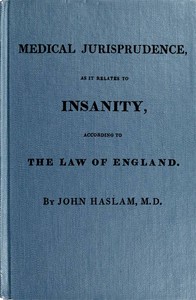
Medical Jurisprudence as it Relates to Insanity, According to the Law of England Book Summary
Published in 1881, Medical Jurisprudence as it Relates to Insanity, According to the Law of England by Henry Maudsley is a fascinating, if somewhat dense, exploration of the legal and medical understanding of mental illness in Victorian England. It’s a product of its time, reflecting both the burgeoning field of psychiatry and the evolving legal frameworks surrounding criminal responsibility. Maudsley, a prominent psychiatrist, attempts to bridge the gap between the courtroom and the consulting room, offering guidance to lawyers and judges on how to assess and understand the mental states of those accused of crimes.
This book is a detailed examination of the legal definitions of insanity in 19th-century England, and how those definitions intersect with medical knowledge of mental disorders. Maudsley meticulously analyzes case law, particularly focusing on the landmark rulings that shaped the legal understanding of diminished responsibility and the 'wild beast test'. He doesn't just present the law; he critiques it, arguing for a more nuanced and scientifically informed approach to determining criminal culpability based on mental illness. The book covers a wide range of mental conditions, from acute mania to chronic melancholia, and explores how these conditions might affect a person's ability to understand the nature and consequences of their actions.
One of the central arguments Maudsley makes is that the legal definition of insanity – primarily based on the cognitive ability to distinguish right from wrong – is insufficient. He points out that individuals can understand intellectually that an act is wrong, yet be compelled to perform it due to irresistible impulses or deeply ingrained emotional disturbances. Consider, for example, someone suffering from obsessive-compulsive disorder who understands stealing is wrong but feels driven to steal to alleviate anxiety. The traditional legal test might not adequately address this kind of compulsion.
Maudsley also emphasizes the importance of considering the degree of mental impairment, not just a binary 'sane' or 'insane' classification. He argues for a spectrum of mental responsibility, where the severity of the illness should correlate with the degree of punishment. He illustrates this with examples of individuals with varying levels of mania – some capable of rational thought interspersed with periods of delusion, others completely lost to their illness. The law, he suggests, should reflect these nuances.
A significant portion of the book is dedicated to the difficulties of proving insanity. Maudsley highlights the unreliability of eyewitness testimony, the potential for malingering (faking illness), and the challenges of reconstructing a person's mental state at the time of the crime. He stresses the need for expert medical evidence, but also cautions against relying solely on the opinions of doctors, as their interpretations can be subjective and influenced by their own biases. He discusses the importance of looking at a person’s history, behavior patterns, and any available documentation to build a comprehensive picture.
Finally, Maudsley advocates for a more humane and rehabilitative approach to dealing with individuals found not guilty by reason of insanity. He criticizes the practice of simply imprisoning them, arguing that they require specialized medical care and a supportive environment to recover and reintegrate into society. He envisions a system of 'criminal lunatic asylums' – institutions designed to provide both security and treatment – as a more effective and ethical alternative to traditional prisons. This was a progressive idea for the time, anticipating modern approaches to forensic psychiatry.
This book is ideal for readers interested in:
- The History of Psychiatry: It provides a detailed snapshot of how mental illness was understood and treated in Victorian England.
- Legal History: It’s a valuable resource for understanding the evolution of the insanity defense in English law.
- Medical Jurisprudence: Anyone studying the intersection of medicine and law will find this book insightful.
- Victorian Social History: The book offers a glimpse into the social attitudes towards mental illness and the criminal justice system of the era.
However, be warned: it's a lengthy and sometimes challenging read, written in the formal prose of the 19th century. It's not a light read, but a rewarding one for those willing to invest the time.
Yes, this book still matters today, though it's a historical document. The fundamental questions Maudsley raises about criminal responsibility, the nature of mental illness, and the role of expert evidence remain central to legal and psychiatric debates. His critique of the simplistic 'right vs. wrong' test for insanity foreshadows modern concepts like diminished capacity and irresistible impulse. Understanding the historical roots of these concepts is crucial for appreciating their current form.
To further explore these themes, a next logical read would be:
| Reading on Gutenburg | Free reading |
| Get Paperback Version on Amazon | Buy a book |
| Suggest Book : Forensic Psychiatry: Clinical, Legal and Ethical Issues Book | Get on Amazon |
Medical Jurisprudence as it Relates to Insanity is a landmark work that offers a unique and valuable perspective on the complex relationship between mental illness and the law. While rooted in its historical context, the book's insights continue to resonate with contemporary discussions about criminal responsibility and the treatment of offenders with mental health problems. It’s a challenging but ultimately rewarding read for anyone interested in the history of psychiatry, law, or the human condition.