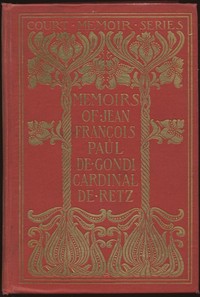
Memoirs of Jean François Paul de Gondi, Cardinal de Retz — Complete Book Summary
Introduction
First published in the early 18th century, "Memoirs of Jean François Paul de Gondi, Cardinal de Retz" offers a firsthand account of the turbulent religious wars and political maneuverings in France during the reigns of Louis XIII and Louis XIV. Written by a high-ranking Catholic nobleman who later became a Cardinal, these memoirs provide a unique perspective on the complex social and political landscape of pre-revolutionary France.
What is this book about?
The book chronicles the life of Jean François Paul de Gondi, known as the Cardinal de Retz, from his youth as a nobleman to his death as a Cardinal of the Catholic Church. It details his participation in the French Wars of Religion, his imprisonment, his return to court, and his service under King Louis XIII and King Louis XIV. The memoirs delve into his political strategies, his relationships with powerful figures like Cardinal Richelieu and Cardinal Mazarin, and his observations on the workings of the French monarchy and the religious conflicts that plagued the nation during this period.
Key Lessons
The memoirs of Cardinal de Retz offer valuable insights into the art of political survival and the complexities of navigating religious and political tension in an era of absolute monarchy and deep-seated religious divisions.
Firstly, the book explores the pragmatic necessity of neutrality in religious conflicts. De Retz, despite being a high-ranking Catholic, describes his attempts to avoid taking sides during the French Wars of Religion and his criticism of the Catholic League's fanaticism. This highlights the difficult position individuals could be in when caught between religious zealotry and political pragmatism. For example, his criticism of the League's intolerance underscores the idea that religious conviction could sometimes hinder rather than help the stability of the state.
Secondly, the memoirs provide a detailed account of the challenges of serving an absolute monarch. De Retz describes the constant political maneuvering required to please the king, the dangers of offending powerful figures at court, and the complex web of alliances and rivalries necessary for advancement. His experiences under Richelieu and Mazarin illustrate how loyalty to the crown often required navigating treacherous personal and political situations, sometimes necessitating silence or compromise on deeply held principles.
Thirdly, the book offers reflections on the nature of power and the role of religion in politics. De Retz's observations on the motivations of various factions and the influence of the Catholic Church on state affairs reveal the intricate relationship between spiritual authority and political power. His insights into court life show how religious affiliations were often used as tools for political advancement or repression, and how figures like Richelin sought to use religious authority to consolidate royal power. These lessons provide a window into the mindset of a key player in one of Europe's most complex religious and political conflicts.
Is this book fit for me?
This book is highly recommended for readers interested in:
- Early modern European history, particularly the French Wars of Religion.
- The history of the Catholic Church during the period of the French monarchy.
- The lives and strategies of historical figures like Cardinal Richelieu and Cardinal Mazarin.
- Understanding the political and religious climate of pre-revolutionary France.
- The art of political survival and court intrigue in an era of absolute monarchy.
It offers a unique, personal perspective on a critical period in European history.
Does it still matter today?
Yes, "Memoirs of Jean François Paul de Gondi, Cardinal de Retz" remains relevant today because it provides fundamental insights into the perennial problems of religious conflict, political maneuvering, and the exercise of power. The themes of religious intolerance, the manipulation of religious differences for political gain, the complexities of navigating power structures, and the consequences of fanaticism are as pertinent now as they were in the 17th century. Understanding how historical figures navigated these challenges offers valuable perspective on contemporary debates around religious pluralism, political polarization, and the balance between state power and individual conscience.
"The Thirty Years' War" by Peter H. Wilson
Why? While "Memoirs of Cardinal de Retz" focuses primarily on France, understanding the broader context of religious wars in Early Modern Europe is crucial. "The Thirty Years' War" provides a comprehensive analysis of the devastating conflict that ravaged the continent and demonstrates the complex interplay of religion, politics, and power on a much larger scale, offering a comparative perspective.
| Reading on Gutenburg | Free reading |
| Get Paperback Version on Amazon | Buy a book |
| Suggest Book : The Thirty Years' War Book | Get on Amazon |
Conclusion
In summary, "Memoirs of Jean François Paul de Gondi, Cardinal de Retz" is a fascinating and historically significant work. It provides an intimate, albeit partisan, view of the French Wars of Religion and the court of the Sun King. Through the eyes of a central figure, readers gain insight into the dangers of religious extremism, the intricate dance of court politics, and the personal costs of navigating a period of intense social and political upheaval. While written from a specific perspective and representing the challenges of its time, the memoirs remain a valuable resource for understanding the dynamics of power, religion, and conflict that continue to shape our world.