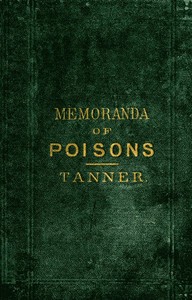
Memoranda on Poisons Book Summary
Published in 1852, Memoranda on Poisons isn’t a thrilling detective novel, but a remarkably detailed and practical guide for coroners, jurists, and anyone needing to understand the effects of poisons. Written by Sir Thomas Dickinson, a prominent British medical practitioner, it's a product of the Victorian era’s fascination – and frequent encounters – with toxicology. It’s a surprisingly readable and fascinating glimpse into a darker side of history, filled with case studies and meticulous chemical breakdowns.
This book is a comprehensive compendium of information about various poisons, both organic and inorganic. Dickinson doesn’t simply list poisons; he details their chemical properties, methods of administration, symptoms of poisoning, post-mortem appearances, and – crucially – the methods for detecting them. He covers everything from common household poisons like arsenic and lye to more exotic substances like strychnine and hydrocyanic acid. It's structured as a series of 'Memoranda,' essentially concise notes intended for quick reference in legal or medical investigations. Throughout, the book emphasizes the importance of careful observation and scientific analysis in determining the cause of death.
One of the most striking lessons from Memoranda on Poisons is the sheer prevalence of poisoning in the 19th century. Dickinson’s case studies, though presented clinically, reveal a society where deliberate and accidental poisoning were relatively common. This wasn't necessarily due to a more malicious populace, but rather to the accessibility of poisons – often used in everyday products like rat poison, dyes, and even medicines – and a limited understanding of toxicology. The book details numerous instances of arsenic being used, often due to its slow-acting nature and difficulty in detection at the time. It really highlights how much safer our modern world is due to regulations and advancements in chemical analysis.
Another key takeaway is the importance of meticulous observation and detailed record-keeping in forensic science. Dickinson repeatedly stresses the need to document every symptom, every post-mortem finding, and every detail of the circumstances surrounding a suspected poisoning. He explains how seemingly minor clues – the color of the skin, the presence of a particular odor, the state of the stomach contents – can be vital in identifying the poison used and establishing the cause of death. This emphasis on thoroughness forms the bedrock of modern forensic investigation. For example, he meticulously describes the changes in the eyes following certain poisonings, a detail crucial for early detection.
The book also demonstrates the evolving understanding of the chemical properties of poisons and their effects on the human body. Dickinson presents poisons not as mystical substances, but as chemical compounds with predictable reactions. He explains how different poisons interfere with various bodily functions – some paralyzing the nervous system, others causing internal hemorrhaging, and still others disrupting the digestive process. This shift towards a scientific understanding of toxicology was instrumental in developing antidotes and improving detection methods. He details the chemical tests used at the time, like Marsh's test for arsenic, and explains their limitations, showing a critical approach to the science itself.
Finally, Memoranda on Poisons underscores the legal ramifications of poisoning and the role of the medical expert in the justice system. Dickinson consistently frames his information within the context of legal investigations, explaining how evidence should be collected and presented in court. He also discusses the challenges of proving poisoning, particularly in cases where the evidence is circumstantial or the poison is difficult to detect. This highlights the ongoing tension between scientific certainty and legal proof, a theme that remains relevant in forensic science today.
This book will appeal to you if:
- You have a strong interest in history, particularly the Victorian era.
- You enjoy forensic science and true crime, and are interested in the historical roots of these fields.
- You have a background in chemistry or medicine, or a general interest in the scientific aspects of toxicology.
- You appreciate detailed, technical writing and aren’t afraid of some dated medical terminology.
- You are fascinated by the darker aspects of human behavior and the ways in which poisons have been used throughout history.
Yes, absolutely. While the specific poisons and detection methods discussed in Memoranda on Poisons have been largely superseded by modern advancements, the fundamental principles of toxicology and forensic investigation remain the same. The book is a valuable historical document that reveals how our understanding of poisons evolved and how forensic science emerged as a discipline. It’s a powerful reminder of the importance of scientific rigor and careful observation in the pursuit of justice. Furthermore, studying historical cases can provide insights into patterns of poisoning and potential motives.
To further explore the history of forensic science, a logical next step would be to delve into the pioneering work of Alphonse Bertillon.
| Reading on Gutenburg | Free reading |
| Get Paperback Version on Amazon | Buy a book |
| Suggest Book : Criminal Investigation Book | Get on Amazon |
Memoranda on Poisons is a fascinating and surprisingly relevant work that offers a unique glimpse into the world of 19th-century toxicology and forensic science. It’s a testament to the power of scientific observation and a chilling reminder of the ever-present dangers of poison. While a niche read, it’s richly rewarding for those interested in history, science, and the darker side of human experience.