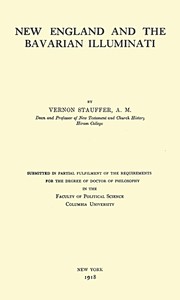
New England and the Bavarian Illuminati Book Summary
The book offers several key insights:
1. **The Power of Conspiracy Narratives:** It demonstrates how fear of powerful, hidden forces (like the Illuminati) can arise from genuine societal anxieties and be amplified by sensationalism and political rhetoric. The accusations served as a framework to explain complex social shifts and the rise of dissenting ideas. For example, when Unitarianism challenged traditional Calvinist doctrines, some critics used Illuminati accusations to label it as a foreign plot for intellectual control.
2. **Historical Paranoia and Xenophobia:** The book highlights how suspicion of foreign influences, particularly those advocating radical social change or secular ideas (like Freemasonry and the Enlightenment), can dominate public discourse. Accusations against the Bavarian Illuminati, an organization often portrayed as anti-religious and revolutionary, tapped into deep-seated American patriotism and fear of subversion.
3. **The Demonization of Freemasonry:** It explores how the Illuminati accusations were closely intertwined with widespread anti-Masonic sentiment in the US during this period. Masonic lodges were seen by many as Illuminati front organizations, contributing to a climate where membership or association could lead to social ostracization or even violence.
4. **The Instrumental Use of History:** The narrative shows how historical societies and figures (like the Illuminati, often conflated with figures like Adam Weishaupt) could be reinterpreted and weaponized to serve contemporary political and social agendas, revealing a tendency to look backward to justify present concerns or anxieties.
If you are interested in the history of conspiracies, secret societies, or the social and political landscape of early 19th-century America, this book is likely for you:
- **History Buffs:** Especially those fascinated by the intersection of Enlightenment thought, religious movements, and political change.
- **Students of Conspiracy Theories:** To understand the historical roots and mechanisms of such beliefs.
- **Those Studying American Social History:** To see how specific events and figures were interpreted through the lens of contemporary fears.
- **Fans of Historical Mysteries:** To explore a period often shrouded in its own myths and legends.
| Reading on Gutenburg | Free reading |
| Get Paperback Version on Amazon | Buy a book |
| Suggest Book : Conspiracy: The Secret World of the Illuminati Book | Get on Amazon |