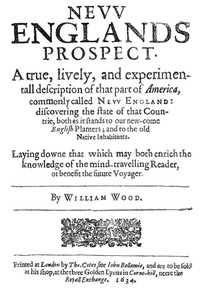
New Englands Prospect A true, lively, and experimentall description of that part of America, commonly called New England: discovering the state of that Countrie, both as it stands to our new-come English Planters; and to the old Native Inhabitants Book Summary
Introduction
William Wood's "New England's Prospect" is a fascinating window into 17th-century colonial America. Written from the perspective of an English settler who arrived in the region that would become Massachusetts, the book offers a detailed and often vivid account of the land, its indigenous inhabitants, and the challenges faced by the new colonists. It's not just a dry historical document; it reflects the complex thoughts and observations of someone trying to understand and make sense of this new world compared to the old.
What is this book about?
Published in 1634, "New England's Prospect" is one of the earliest detailed descriptions of colonial life in New England. William Wood, likely a clergyman who arrived early in the settlement, wrote it partly as a guide for newcomers and partly as a commentary on the Puritan enterprise. The book covers a wide range of topics including:
- Geography and natural features of the region
- Descriptions of Native American tribes and their societies, economies, and spiritual beliefs
- Accounts of the difficulties settlers faced, including disease, conflict, and establishing settlements
- Observations on the relationship between the colonists and the Native Americans
- Reflections on the 'godly' nature of New England society compared to England
Key Lessons
Wood's book offers valuable insights into the colonial mindset and the complexity of early American encounters:
1. Detailed Observations of Native Societies: Unlike many contemporary accounts focused solely on conflict or removal, Wood provides surprisingly detailed and sometimes sympathetic descriptions of various Native American groups (like the Wampanoag and Narragansett). He describes their dwellings, clothing, hunting and fishing techniques, social structures, religious practices (including the 'pequod' concept of the Great Spirit), and their ways of life that were often quite different from European norms. For example, his descriptions of their sophisticated understanding of the natural world and sustainable living practices stand out.
2. The Reality of the Frontier Experience: Wood candidly describes the harsh realities settlers faced beyond the 'godly' narrative. He details the prevalence of diseases like malaria, the dangers of frontier living, the challenges of clearing land, and the constant threat of conflict with Native American tribes (like the ongoing Narragansett wars). This provides a ground-level view of colonial vulnerability and struggle, contrasting with later romanticized versions of the 'Pilgrim Fathers'.
3. The 'New World' as a Separate Entity: Wood emphasizes how distinct New England felt, not just geographically but culturally and spiritually. He contrasts the perceived wilderness and 'godly' simplicity of New England with the corruption and 'popery' (as he saw it) of England. This sense of a unique destiny and environment is a recurring theme, showing how the settlers interpreted their surroundings through their own religious and cultural lens.
4. The Complex Nature of Interactions: Rather than presenting a simple narrative of savages versus civilized settlers, Wood acknowledges the complex interactions and dependencies. He notes how Native American labor and knowledge (like farming techniques) were often essential for the survival of the colonies, challenging the purely expansionist view.
Is this book fit for me?
This book is particularly suited for readers interested in:
- Early American colonial history, especially the founding period of New England
- The history of American literature and first-hand accounts from the 17th century
- The complex and often misunderstood relationship between early European settlers and Native Americans
- Primary sources that offer a contemporary perspective on the challenges of colonial life
- Understanding the Puritan worldview and the concept of 'godly' community
It provides a valuable, albeit sometimes biased, primary source document that complements secondary historical analyses.
Does it still matter today?
Yes, to a significant extent. "New England's Prospect" remains relevant because it offers a direct, contemporary view of the foundational period of American history. It helps us understand:
* **The Roots of American Identity:** How the Puritan experiment, with its emphasis on community, religion, and self-governance, shaped early American identity.
* **Early Interactions with Indigenous Peoples:** It provides one of the earliest, detailed European accounts, forcing us to confront the perspectives and biases of the time regarding Native Americans, which is crucial for ongoing discussions about indigenous rights and historical reconciliation.
* **Environmental History:** Wood's descriptions of the landscape and Native American land use offer insights into the pre-colonial and early colonial environment, informing environmental history studies.
* **Understanding Historical Bias:** It serves as a primary source example of the biases and limitations inherent in historical accounts written from a specific (colonial) perspective.
Because the book is quite old, its language and some perspectives may feel dated or challenging for a modern reader unprepared for 17th-century English and Puritan views.
| Reading on Gutenburg | Free reading |
| Get Paperback Version on Amazon | Buy a book |
| Suggest Book : A New England Primer: An Anthology of Writings and Documents, 1620-1850 Book | Get on Amazon |
Conclusion
William Wood's "New England's Prospect" is a foundational text offering invaluable primary source material for understanding the early colonial period in New England. While written with the biases and perspectives of its time, its detailed observations about the land, the diverse Native American populations, and the harsh realities faced by settlers provide crucial context for American history. It remains a key read for anyone seeking to grasp the complexities of the 'New World' encounter and the origins of colonial American society.