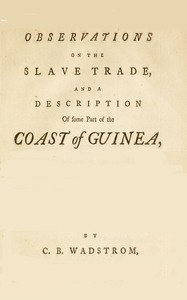
Observations on the slave trade and a description of some part of the coast of Guinea, during a voyage, made in 1787, and 1788, in company with Doctor A. Sparrman and Captain Arrehenius Book Summary
Published in 1791, Observations on the slave trade and a description of some part of the coast of Guinea, during a voyage, made in 1787, and 1788, in company with Doctor A. Sparrman and Captain Arrehenius is a firsthand account of the realities of the transatlantic slave trade by Swedish botanist and explorer, Adam Afzelius. It's a significant historical document, offering a detailed look at the conditions endured by enslaved Africans and the European operations that fueled this brutal system.
This book chronicles Afzelius’s journey along the West African coast, specifically focusing on the region known as Guinea, during the late 18th century. He details his observations of the landscape, the flora and fauna, and most importantly, the interactions between Europeans and Africans in the context of the slave trade. Afzelius meticulously describes the process of acquiring slaves – from initial encounters with African traders to the horrific conditions of the ships transporting them to the Americas. He also provides insights into the political and social structures of the African societies he encountered, attempting to understand the factors that contributed to the trade’s existence. The book is a blend of scientific observation, travelogue, and moral commentary.
One of the most striking lessons from Afzelius’s account is the sheer dehumanization inherent in the slave trade. He doesn’t shy away from describing the physical and psychological suffering of the enslaved people. He details the cramped, unsanitary conditions on the ships, the rampant disease, and the casual cruelty inflicted by the crew. He notes how Africans were viewed not as individuals with rights and dignity, but as commodities to be bought, sold, and exploited. This isn’t presented as abstract moralizing, but as a series of concrete, disturbing observations. For example, he describes how enslaved people were routinely ‘measured’ like livestock to assess their value, and how resistance, even minor, was met with brutal punishment.
Furthermore, the book reveals the complexities of African involvement in the slave trade. Afzelius doesn’t portray Africans simply as victims. He acknowledges that African rulers and traders participated in the exchange, often trading slaves for European goods like firearms, textiles, and alcohol. However, he also highlights how this participation was often driven by pre-existing conflicts and power dynamics, and how the demand for slaves created and exacerbated these issues. He illustrates this by describing the intricate negotiations and power plays between European traders and African intermediaries, showing that the trade wasn’t a simple one-way transaction but a web of relationships and dependencies.
Afzelius also provides a valuable, though sometimes problematic from a modern perspective, anthropological glimpse into the cultures of West Africa. He attempts to describe the customs, beliefs, and social structures of the various groups he encountered. While his observations are inevitably filtered through a European lens, they offer a rare contemporary record of African life before the full impact of colonialism. He details aspects of their governance, religious practices, and economic systems, providing a nuanced picture that challenges simplistic stereotypes. He notes, for instance, the sophisticated trading networks that existed within Africa long before the arrival of Europeans.
Finally, the book underscores the economic motivations driving the slave trade. Afzelius clearly demonstrates how the demand for labor in the Americas, particularly for plantation agriculture, fueled the entire system. He details the profits made by European traders and ship owners, and the role of colonial governments in facilitating the trade. He shows how the slave trade was deeply embedded in the global economic system of the time, and how it benefited a wide range of actors, not just those directly involved in the transportation of enslaved people. He points out the specific goods desired by the African traders, and how European merchants catered to those demands to secure slaves.
This book is ideal for readers interested in:
- History of the Transatlantic Slave Trade: A primary source account offering detailed insights into the mechanics and realities of the trade.
- 18th-Century Exploration and Travel: A fascinating travelogue of West Africa during a specific historical period.
- Early Anthropology: Observations of African cultures and societies, though viewed through a colonial lens.
- Ethical and Moral Dilemmas: A thought-provoking exploration of the moral implications of slavery and the complexities of historical responsibility.
- Primary Source Research: A valuable document for scholars and students studying this period.
Absolutely. While the transatlantic slave trade in its original form is over, its legacy continues to shape societies around the world. Understanding the historical roots of racism, inequality, and systemic injustice is crucial for addressing these issues today. Afzelius’s account serves as a stark reminder of the horrors of slavery and the importance of fighting against all forms of oppression. It also highlights the dangers of economic exploitation and the need for ethical trade practices. The book’s detailed descriptions of the dehumanization process are particularly relevant in understanding contemporary forms of discrimination.
Yes, it does. To further explore the lasting impact of slavery and its connection to modern racial disparities, I recommend reading:
| Reading on Gutenburg | Free reading |
| Get Paperback Version on Amazon | Buy a book |
| Suggest Book : The Half Has Never Been Told: Slavery and the Making of American Capitalism Book | Get on Amazon |
Observations on the slave trade is a challenging but essential read. It’s a disturbing account of human suffering, but it’s also a valuable historical document that offers important lessons about the complexities of the past and their relevance to the present. Afzelius’s work, while a product of its time, provides a powerful and unflinching look at one of the darkest chapters in human history.