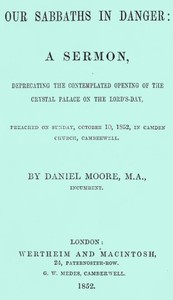
Our Sabbaths in Danger A Sermon, deprecating the contemplated opening of the Crystal Palace on the Lord's-Day Book Summary
Introduction
This summary addresses the sermon 'Our Sabbaths in Danger: A Sermon, deprecating the contemplated opening of the Crystal Palace on the Lord's-Day,' delivered in the mid-to-late 19th century. The core issue debated was whether the magnificent Crystal Palace building, famous from the Great Exhibition of 1851, should be open to the public on Sundays, the traditional day of rest for Christians. The sermon strongly opposes this idea, arguing that allowing commerce and public gathering on the Sabbath detracts from its sacred purpose.
What is this book about?
This work is a religious sermon responding to the proposal to open the Crystal Palace on Sundays. The author expresses deep concern that doing so would profane the Sabbath day, a day set apart by God for rest, worship, and spiritual activities. The sermon draws upon biblical principles and contemporary religious sensibilities to argue that mixing the sacred with the secular, particularly in a large public venue like the Palace, is inappropriate and harmful to religious devotion and societal morality. It reflects the anxieties of the Victorian era regarding the pace of social change, the influence of new technologies and commerce on traditional values, and the perceived desecration of holy days.
Key Lessons
1. The Sanctity of the Sabbath: The sermon emphasizes the biblical command to keep the Sabbath holy as a day of rest and worship. It argues that deliberately using a major landmark like the Crystal Palace for commercial purposes on this day treats the Sabbath as just another day for public entertainment and work, undermining its spiritual significance. Example: Using the Palace for shopping or leisure on Sunday contradicts the principle of setting aside time for God.
2. Conflict Between Commerce and Piety: The author perceives a fundamental conflict between the spirit of business and religious devotion. Opening the Palace on Sunday is seen as prioritizing economic activity and public access over spiritual concerns. The sermon suggests this commercialization of a space traditionally associated with awe (like the exhibition hall) on a holy day is spiritually dangerous. Example: Allowing paid admission and business transactions on the Sabbath is viewed as profane.
3. Defining and Protecting Sacred Space: The sermon implicitly argues for the protection of spaces (like churches and, by extension, parts of public life) as sanctuaries removed from worldly commerce. The Crystal Palace, despite its secular function, is being considered for a sacred purpose (or lack thereof), highlighting the struggle to maintain boundaries between the sacred and the profane in a rapidly changing society. Example: The author implies that the Palace's grandeur makes it unsuitable for merely commercial use on Sunday.
4. The Role of Public Influence: It suggests that places of public gathering, especially impressive ones like the Crystal Palace, have a powerful influence on society's habits and morals. Introducing Sunday commerce into such a prominent venue could normalize working and shopping on the Sabbath, changing societal norms. Example: If the Palace is open, people might be tempted to visit on Sunday rather than attending church or resting.
Is this book fit for me?
This sermon is primarily a historical religious text. It is most suitable for readers interested in:
- Victorian religious history and social customs.
- The history of the Sabbath and its observance.
- The impact of the Great Exhibition and the Crystal Palace on British society.
- The intersection of religion, commerce, and public life in the 19th century.
- Those studying the history of debates around secularization or the changing nature of sacred space.
It offers a perspective on how deeply held religious beliefs shaped responses to technological and social novelty during a period of rapid change.
Does it still matter today?
Yes, the underlying tension explored in this sermon between commercial interests and religious observance continues to be relevant. Debates about Sunday shopping laws, the operation of businesses on the Sabbath, and the desecration of religious spaces or times persist in various forms. The core question of whether economic activity should dominate or be subordinate to spiritual and communal needs on days considered holy remains a point of discussion in many faith traditions. The sermon's concern about the influence of public venues on societal habits also echoes contemporary anxieties about commercialization in everyday life, including public spaces and holidays.
Therefore, the specific historical context (Crystal Palace, 19th-century Britain) is different, but the broader themes of balancing secular progress with religious values and the importance of preserving the sanctity of time and space are timeless.
| Reading on Gutenburg | Free reading |
| Get Paperback Version on Amazon | Buy a book |
| Suggest Book : The Sabbath: A Day of Rest and Worship Book | Get on Amazon |
Conclusion
'Our Sabbaths in Danger' provides a valuable window into the religious sensibilities and societal conflicts of Victorian Britain. It captures a specific historical moment where rapid change, national pride in a new landmark, and deep-seated religious traditions clashed. While the central argument is about the Crystal Palace, the sermon's core message about the perceived desecration of the Sabbath by commerce and the importance of maintaining its sanctity remains a resonant theme. It is a concise piece that, despite its brevity and polemical nature, offers insight into how faith guided the interpretation of the modern world during a pivotal period of British history.