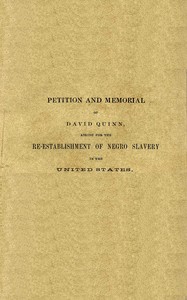
Petition and memorial of David Quinn, asking for the re-establishment of Negro slavery in the United States Book Summary
Introduction
This summary explores 'Petition and Memorial of David Quinn, asking for the re-establishment of Negro slavery in the United States.' This peculiar and disturbing document is a plea written in 1860, likely from the perspective of a staunch defender of the institution of slavery, possibly representing pro-slavery sentiments prevalent in certain regions, particularly in the South, as the United States approached the Civil War. It serves as a stark historical artifact, revealing the arguments and ideologies that fueled the defense of chattel slavery during a critical period in American history.
What is this book about?
The book presents a formal petition and memorial submitted by an individual named David Quinn. Its central, explicit purpose is to appeal to authorities (likely state or national) advocating for the return of African Americans to the brutal system of chattel slavery that existed in the United States before the Civil War. The text argues for the perceived economic necessity, social order, and perhaps divine right or natural order of slavery, reflecting the deep-rooted pro-slavery ideology that was a major cause of the impending conflict. It is a document steeped in the defense of a morally reprehensible institution based on racial subjugation and human bondage.
Key Lessons
This book, though representing a deeply problematic and offensive viewpoint, offers significant historical insights:
1. The Persistence of Racist Ideology: The arguments presented in Quinn's petition reveal how pervasive and virulent racist beliefs were in certain segments of American society well into the 19th century. These beliefs were not just personal prejudices but were used to construct elaborate justifications for a system of institutionalized oppression. The petition likely reflects the pseudoscientific racist theories popular at the time, portraying Black people as inherently suited for servitude and incapable of self-governance or contributing equally to society. Understanding this helps explain the immense resistance to emancipation and civil rights in later decades.
2. The Nature of White Supremacy: Quinn's petition demonstrates how white supremacy functioned as a political and social organizing principle. It wasn't just about disliking Black people; it was about maintaining power, control, and economic advantage. The defense of slavery was intertwined with fears of social upheaval, loss of property, and the erosion of the Southern way of life. This highlights how racial hierarchies were often maintained and defended through explicit political advocacy and legal means.
3. The Danger of Historical Revisionism and Weaponized History: The petition itself is a piece of history, but the arguments it contains were used to legitimize ongoing injustice. It shows how proponents of slavery selectively interpreted history, scripture, and science to create a narrative in their favor. This serves as a cautionary tale about how historical arguments can be manipulated to support harmful ideologies and maintain the status quo, even in the face of changing social and political landscapes.
Is this book fit for me?
This book is a primary source document, representing a specific, controversial, and offensive perspective from a particular historical moment. It is most suitable for:
- Historians and Students of American History: To understand the depth of pro-slavery ideology, the arguments used to defend it, and the social and political climate leading up to the Civil War. It provides direct insight into the mindset of slavery's defenders.
- Students of American Culture and Racism: To analyze the development and persistence of racist ideas and their role in shaping American institutions and society.
- Those Writing or Analyzing Counter-Narratives: To engage critically with historical documents that challenge conventional understandings of American history.
This book is **not** suitable for:
- General readers seeking an engaging or uplifting narrative; It is a serious, often grim, historical document.
- Students or readers without a background in American history; The arguments require contextual understanding to fully grasp their historical significance and problematic nature.
- Individuals primarily seeking to understand the evils of slavery; While it reveals those evils indirectly through the arguments against abolition, the book itself focuses on the defense.
Does it still matter today?
Yes, this book remains relevant today. It serves as a stark reminder of the virulent racism and the lengths to which proponents of a hateful ideology were willing to go to defend it. Understanding these historical arguments is crucial for comprehending the long and ongoing legacy of systemic racism in the United States. The ideas about inherent inferiority, the supposed economic necessity of racial hierarchy, and the willingness to use government channels to perpetuate oppression resonate with contemporary issues of racial injustice and the debates surrounding race relations.
| Reading on Gutenburg | Free reading |
| Get Paperback Version on Amazon | Buy a book |
| Suggest Book : White Supremacy in the Twenty-First Century America Book | Get on Amazon |
Conclusion
David Quinn's petition is a chilling artifact of American history, representing the defense of a barbaric institution rooted in profound racism. While offensive and representing a minority, extremist viewpoint, it is essential to engage with such primary sources to understand the depth of prejudice that shaped the nation. It underscores the continuous struggle against racism and the importance of vigilance against ideologies that seek to subordinate any group based on identity. To delve deeper into the ongoing nature of racial issues, exploring contemporary analyses is recommended. Tags : History - American Politics