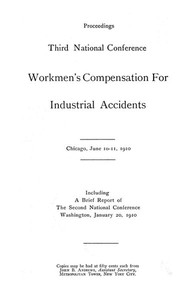
Proceedings, Third National Conference Workmen's Compensation for Industrial Accidents Book Summary
Introduction
This summary covers the book 'Proceedings, Third National Conference Workmen's Compensation for Industrial Accidents', published in 1912. The text details the deliberations and findings of a significant gathering of experts, legal figures, and industrial leaders focused on the complex issue of compensation for workers injured on the job. It reflects the evolving landscape of industrial safety and responsibility during the early 20th century.
What is this book about?
Published in 1912, this work presents the proceedings (discussions, presentations, resolutions) from the Third National Conference dedicated to Workmen's Compensation for Industrial Accidents. It compiles the arguments, evidence, and recommendations put forth by attendees as they debated the principles, practicalities, and legal frameworks for compensating workers who suffer injuries resulting from their employment. The book delves into the types of accidents, the determination of liability, the calculation of compensation amounts, and the administrative challenges of implementing such systems nationwide. It serves as a valuable historical document reflecting the intense debate surrounding industrial responsibility and worker protection during a period of rapid industrialization in the United States.
Key Lessons
This 1912 conference proceedings offers a fascinating glimpse into the foundational debates surrounding workplace safety and compensation. A central theme explores the tension between employer interests in minimizing costs and worker needs for adequate support after injury. Presentations likely detailed numerous case studies and statistical analyses showing the human and economic costs of industrial accidents, arguing persuasively for state-sponsored compensation systems to replace piecemeal, often employer-determined payouts. Another crucial lesson concerns the difficulty in proving negligence. The book likely highlights how industrial settings often made it hard to definitively assign fault, leading advocates to push for systems based on presumed employer responsibility for certain types of work-related injuries, shifting away from the traditional 'no-fault' tort system. Furthermore, the text probably emphasizes the practical challenges of administration – how to fairly assess claims, prevent fraud, and manage the financial burden on employers and insurers. It underscores the need for standardized laws and procedures across different industries and states, a challenge still faced by modern regulatory bodies. The discussions would also have addressed the balance between compensating workers and maintaining industrial competitiveness, revealing early 20th-century societal priorities and conflicts. Finally, the book serves as a historical benchmark, showing how ideas about worker protection were being formally codified and debated, laying groundwork for the modern workers' compensation system.
Is this book fit for me?
This book is particularly suitable for:
1. History Buffs: Readers interested in the social, economic, and legal history of the United States around the turn of the 20th century, especially the Progressive Era reforms aimed at improving working conditions.
2. Legal and Labor Studies Students/Professionals: Individuals studying the development of labor law, workers' rights, tort law, or industrial relations will find the debates and proposed solutions historically significant.
3. Those researching Industrial Safety: Understanding the origins of systematic approaches to workplace safety and accident prevention.
4. Policy Analysts: Those examining the evolution of social welfare programs and government's role in regulating industry. The book provides primary source material on the arguments for and against comprehensive compensation schemes.
5. General Readers Seeking Historical Insight: Anyone wanting to understand the roots of modern workplace safety regulations and employer-employee relations.
Does it still matter today?
Yes, absolutely. While the specific debates and legal frameworks presented in 1912 are now outdated, the core issues they addressed remain profoundly relevant. The book provides essential historical context for understanding the development of the modern workers' compensation system, which is still the primary mechanism in most U.S. states for compensating injured workers. It highlights the ongoing struggle between acknowledging workplace risks and the costs of mitigating them. The discussions on defining 'work-related' injuries, determining fair compensation levels, and balancing employer liability with economic competitiveness continue to resonate in contemporary debates about workplace safety standards, insurance policies, and labor legislation. Understanding the historical roots helps clarify why certain aspects of workers' compensation exist and why reforms continue to be proposed today.
| Reading on Gutenburg | Free reading |
| Get Paperback Version on Amazon | Buy a book |
| Suggest Book : Compensation: Workers' Injury, Jobs, and the Politics of Risk Book | Get on Amazon |
Conclusion
'Proceedings, Third National Conference Workmen's Compensation for Industrial Accidents' is a vital historical document. It captures a critical moment when the nation was grappling with the consequences of industrialization and the moral and practical imperative to protect workers. While superseded by modern laws and regulations, its content remains relevant for historians, students, and professionals in law, labor studies, and public policy. It illuminates the origins of a system that continues to shape workplace safety and employer-employee relations in the United States. For further exploration of the topic, 'Compensation: Workers' Injury, Jobs, and the Politics of Risk' offers a more contemporary and analytical perspective on the ongoing challenges and politics surrounding workers' compensation systems.