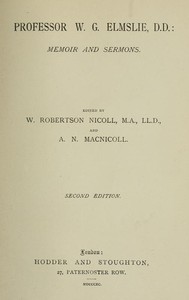
Professor W. G. Elmslie, D.D.: Memoir and Sermons Book Summary
Introduction
This book offers a glimpse into the life and thought of Professor W. G. Elmslie, a significant figure in Scottish theology during the early 20th century. Comprising his memoirs and selected sermons, it provides insight into his personal journey of faith, his approach to biblical exegesis, and his views on the role of the church and Christian living during his time.
What is this book about?
"Professor W. G. Elmslie, D.D.: Memoir and Sermons" is an archival collection presenting the personal reflections and religious discourses of William George Elmslie. Born in 1859, Elmslie was a prominent Scottish theologian who held influential positions within the Free Church of Scotland. The memoir portion likely details his own spiritual development, his experiences in the church, and his engagement with contemporary theological issues. The sermons section offers practical guidance and exposition on scripture, often addressing themes relevant to Victorian and Edwardian society, such as the authority of the Bible, the nature of faith, and the importance of a living Christian church. It's a primary source document, capturing the voice and mind of a key figure in late Victorian and early 20th-century Scottish Presbyterianism.
Key Lessons
Elmslie's work, particularly his sermons, reflects several key themes and approaches that were central to his ministry:
1. Historical Exegesis: Elmslie often emphasized understanding the Bible within its historical context. He believed that to grasp the meaning of scripture, one must consider the culture, language, and historical circumstances of its original audience. This contrasts with purely timeless or abstract readings. For example, his interpretations of biblical narratives would likely incorporate the ancient Near Eastern setting or the social norms of the time they were written.
2. Practical Theology: His sermons frequently aimed to apply biblical principles to the practicalities of daily life. He sought to bridge the gap between the ancient text and the modern reader's experience, encouraging listeners to find relevance in the faith for their everyday challenges, relationships, and decisions. He addressed issues pertinent to his era, showing how Christian principles could guide conduct in a rapidly changing industrial and social landscape.
3. Emphasis on the Living Church: Elmslie placed great importance on the vitality and mission of the local church. His writings reflect a belief in the church as a community called by God to specific tasks and responsibilities, grounded in the teachings of Christ. He likely wrote about the need for active witness, mutual support among members, and faithful stewardship of the traditions and sacraments.
4. Personal Piety and Spirituality: While rooted in Reformed theology, Elmslie also valued personal spiritual experience and growth. His memoirs and sermons likely touch upon the individual's relationship with God, the importance of prayer, meditation on scripture, and responding to the 'still, small voice' of God. He encouraged a disciplined, reflective personal piety alongside corporate worship.
5. Defense of Biblical Authority: Given the theological controversies of his time, especially concerning liberal theology and higher criticism, Elmslie was likely firm in his defense of the Bible's divine inspiration and authority. His sermons and writings would have addressed challenges to traditional interpretations and affirmed the enduring truth and reliability of scripture.
Is this book fit for me?
This book would be particularly suitable for:
- Students of theology or history, especially those focusing on Scottish or Victorian/Edwardian religious history.
- Individuals interested in the life and work of W. G. Elmslie specifically.
- Those wanting to understand the nuances of Reformed Presbyterian thought in the late 19th and early 20th centuries.
- Sermon enthusiasts looking for examples of biblical interpretation and application from an earlier era.
- Academics and researchers working on the history of Christianity or specific denominational traditions.
It may be less relevant for general readers seeking contemporary spiritual guidance or those unfamiliar with the historical period and theological debates of the time.
Does it still matter today?
Yes, this book still holds value today, primarily as a historical document and a window into a specific time and theological perspective. While the direct application of his sermons to modern societal issues might be limited, his emphasis on historical context for biblical interpretation remains a valuable approach. Understanding the past helps shape our present understanding of scripture and faith. Furthermore, his reflections on the nature of faith, piety, and the church's mission provide insights into the enduring core of Christian living. The challenges of maintaining faithfulness in a changing world, the importance of community, and the need for personal spiritual discipline are timeless themes.
| Reading on Gutenburg | Free reading |
| Get Paperback Version on Amazon | Buy a book |
| Suggest Book : A History of Christianity by Diarmaid MacCulloch Book | Get on Amazon |
Conclusion
"Professor W. G. Elmslie, D.D.: Memoir and Sermons" offers a valuable resource for understanding a significant figure in early 20th-century Scottish Christianity and the theological landscape of the period. While perhaps not a primary text for contemporary spiritual practice, it serves well as a historical study piece, providing rich material for those interested in the development of Reformed thought, biblical interpretation methods, and the life of the church in another era. To gain broader perspective on the history of Christianity, consider reading "A History of Christianity" by Diarmaid MacCulloch.