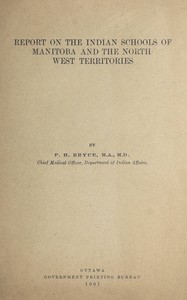
Report on the Indian schools of Manitoba and the North-West Territories Book Summary
Introduction
This report, originally published in 1896, offers a critical perspective on the treatment of Indigenous peoples within Canada's education system during the late 19th century. Authored by an Anglican minister and educator, it details his observations and findings regarding the Indian schools in Manitoba and the North-West Territories (present-day Alberta, Saskatchewan, and parts of the Yukon and Northwest Territories). While ostensibly a report on educational conditions, its content reveals profound concerns about the ethical and humanitarian implications of the assimilationist policies being actively pursued by the Canadian government and its missionary partners.
What is this book about?
The report is a firsthand account and investigation into the state of residential and day schools established for Indigenous children in Western Canada during the 1880s and early 1890s. The author, a clergyman, traveled extensively, visiting numerous schools and communities. He documents the physical conditions of the institutions, the curriculum which overwhelmingly emphasized Western culture and Christianity while neglecting Indigenous languages and traditions, and the relationship between the schools and the broader colonial administration and settlers. The central theme is the clash between the Canadian government's stated policy of education and civilization and the practical methods employed, which often included neglect, abuse, and the deliberate suppression of Indigenous identities.
Key Lessons
1. **Education as a Tool of Colonization:** One of the most significant lessons is the recognition that education within these schools was not merely about imparting knowledge but was fundamentally a tool for cultural assimilation and the erasure of Indigenous identities. The author details how Indigenous languages were actively suppressed, traditions were condemned, and Western religious and cultural norms were aggressively imposed. This serves as an early example of how education systems can be weaponized to dismantle cultural sovereignty.
2. **Systemic Neglect and Poor Conditions:** The report meticulously documents the appalling lack of resources, inadequate housing, insufficient food, and poor sanitation in many of the schools. This wasn't necessarily due to lack of funding in every case, but rather reflected a systemic disregard for the well-being of Indigenous children, prioritizing colonial objectives over their basic needs and welfare. This highlights how institutional indifference can manifest in tangible, harmful ways.
3. **Rigid Curricula and Lack of Indigenous Input:** The curriculum was rigidly controlled, focusing on academics, manual labor, and religious instruction aimed at preparing students for assimilation into settler society. There was virtually no room for Indigenous perspectives, knowledge systems, or local history. This underscores the importance of culturally responsive education and the dangers of imposing external frameworks without consideration for or integration of the students' own heritage.
4. **The Complexity of Indigenous Responses:** While the report focuses on the schools' negative impacts, it also touches upon the complex ways Indigenous communities responded. Some parents sent children away hoping for education and opportunity, while others resisted or sought to protect their children. This complexity reminds us that Indigenous peoples were not passive victims but actively negotiated and contested colonial policies, demonstrating agency in the face of oppression.
Is this book fit for me?
Yes, this book is particularly suited for:
- Students and educators interested in Canadian history, especially the history of Indigenous-settler relations and the legacy of residential schools.
- Readers seeking foundational texts that illuminate the early stages and motivations behind the residential school system, which later expanded nationally.
- Anyone wanting to understand the historical roots of cultural assimilation policies and their devastating consequences.
- Researchers and academics studying colonialism, education, missionary activities, or social reform in North America during the 19th century.
It provides a valuable, critical perspective from within the colonial system itself, offering insights that are foundational to understanding later, more infamous developments.
Does it still matter today?
Absolutely. While this report dates back to 1896, its core themes and findings remain profoundly relevant. It offers an early, documented critique of policies that were precursors to the systematic and much more widespread residential school system established later in Canada (under the Indian Residential Schools system, which operated until the late 20th century). The author's concerns about neglect, forced assimilation, and the use of education as a colonial tool laid bare the foundational ideologies that persisted and evolved, contributing directly to the intergenerational trauma experienced by Indigenous communities today. This report provides crucial historical context for understanding the ongoing struggles for reconciliation, the recognition of Indigenous rights, and the efforts to revitalize Indigenous languages and cultures. It underscores that the roots of contemporary issues are deep and complex, originating from such historical interventions.
| Reading on Gutenburg | Free reading |
| Get Paperback Version on Amazon | Buy a book |
| Suggest Book : Amerasian Voices: Ethnic Identity and the Politics of Transmission in Cold War Vietnam Book | Get on Amazon |
Conclusion
In summary, 'Report on the Indian schools of Manitoba and the North-West Territories' is a historically significant document that provides an early, critical insider's view of the Canadian colonial project of assimilating Indigenous peoples through education. While written from a perspective shaped by the biases and limitations of its time, its detailed observations on neglect, the suppression of Indigenous identity, and the instrumental use of education remain powerful and disturbing. The report serves as an essential piece of historical evidence, illustrating the long-standing, deliberate nature of policies that would later culminate in the devastating residential school system. Its enduring relevance lies in its clear documentation of how cultural erasure and systemic neglect began, making it a vital read for understanding Canada's complex and often painful relationship with its Indigenous peoples. Given its age and specific focus, reading a more recent work on the broader history or specific impacts of the residential school system would be a natural next step to fully grasp the evolution and consequences of these policies.