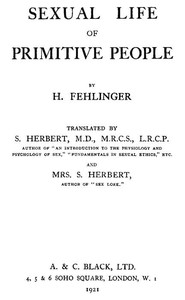
Sexual Life of Primitive People Book Summary
Kroeber's book uses extensive ethnographic data from various 'primitive' or indigenous societies (primarily from Africa, Asia, the Pacific, and the Americas) to construct a picture of human sexuality 'in the natural state' or in early stages of development.
His central thesis posits that sexuality in these societies is fundamentally different from modern Western sexuality. He argues that primitive sexuality is:
- Less Reproductive, More Expressive: While reproduction was certainly important, Kroeber emphasizes that sexual activity in many primitive societies serves other purposes like pleasure, social bonding, emotional expression, and the release of surplus energy.
- More Open and Fluid: He suggests greater fluidity in gender roles and potentially more permissive or varied sexual practices compared to the stricter norms of contemporary society.
- Integrated into Social Life: Sexuality is often viewed as a natural, life-affirming force integrated into rituals, social structures, and daily life, rather than being something hidden or shameful.
- Less Institutionalized: Unlike modern societies with formal marriage, divorce laws, and complex sexual morality codes, Kroeber sees primitive sexuality as operating with fewer external constraints, though internal social norms still exist.
The book attempts to use evolutionary theory and cross-cultural comparison to argue that these characteristics represent a more 'primitive' or 'natural' state, from which modern, often repressed, sexuality has deviated.
The book provides a lens through which to examine the anthropological approach to sexuality during a specific historical period. Kroeber meticulously compiled data from numerous sources, demonstrating an anthropological breadth that was characteristic of the era. However, his interpretation of 'primitiveness' is arguably problematic. He often presented the variations he observed not as equally valid cultural practices, but as deviations from some idealized norm he implied was inherent to earlier human stages. This reflects a now-outdated evolutionary perspective that viewed cultures as progressing towards a single, superior model.
Another key lesson, perhaps unintentional in hindsight, concerns the potential biases inherent in studying sexuality, especially through male, Western eyes. Kroeber's work, while groundbreaking in its explicit discussion, was influenced by the limitations and assumptions of mid-20th-century anthropology. Critics point out that his focus and interpretation sometimes reinforced rather than challenged contemporary stereotypes about 'primitive' or non-Western societies. This highlights the importance of critically examining the researcher's own cultural background and potential biases.
Furthermore, the book's methodology and theoretical framework, particularly its reliance on evolutionary concepts and the idea of a singular 'natural state,' have been heavily critiqued. Modern anthropology understands sexuality as culturally constructed and diverse across all societies, not something that can be easily ranked or traced through a linear evolution. Reading Kroeber thus serves as a valuable exercise in understanding how anthropological theories about sexuality have evolved, moving from biological determinism and evolutionary stages towards a more nuanced, culturally relativistic approach.
This book might be suitable if:
- You are a student of anthropology, history, or sociology interested in the history of these fields themselves, particularly regarding sexuality.
- You want to understand the specific arguments and assumptions that shaped anthropological thought mid-20th century.
- You are curious about the development of ideas around human sexuality, gender, and culture, even if you find Kroeber's views challenging.
- You are prepared to engage critically with the text, recognizing its dated perspectives, potential biases, and the significant body of scholarly critique that exists.
You might want to avoid it if:
- You are looking for contemporary anthropological perspectives on sexuality.
- You seek accurate, unbiased information about specific 'primitive' societies' sexual practices.
- You dislike outdated evolutionary theories or sexist assumptions.
Yes, the book still matters today primarily for its historical and critical value. It serves as a crucial case study illustrating:
- The evolution of anthropological thought: How scholars moved from viewing sexuality through a biological, often deterministic, lens to understanding it as culturally constructed.
- Challenging ethnocentric and sexist views: It highlights how dominant cultural paradigms (like Victorian morality) have historically shaped interpretations of 'primitive' sexuality.
- The importance of critical reading: It demonstrates how even pioneering works can be flawed, biased, or based on incomplete data, necessitating rigorous critical analysis.
- Understanding the context of past debates: It provides insight into how sexuality was discussed and contested in the mid-20th century, informing later social movements.
However, as a source of data on actual practices within the societies studied, its value is extremely limited and superseded by more recent, ethically sound anthropological research. It represents a particular historical viewpoint rather than objective truth.
| Reading on Gutenburg | Free reading |
| Get Paperback Version on Amazon | Buy a book |
| Suggest Book : Womanhood in the Tropics Book | Get on Amazon |