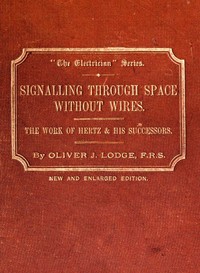
Signalling across space without wires being a description of the work of Hertz & his successors Book Summary
The book offers several key insights into the process of scientific discovery and technological innovation:
1. Proof is Power: The Importance of Experimental Validation
The core lesson revolves around the power of empirical evidence. While Maxwell's equations provided a stunning theoretical framework, it was Hertz's meticulous laboratory experiments that definitively proved the existence of electromagnetic waves. His success demonstrates that groundbreaking scientific theories require rigorous experimental testing to gain acceptance and unlock their potential.
2. Incremental Progress Fuels Breakthroughs
The narrative emphasizes that Hertz's initial discoveries were just the beginning. Successive researchers, building upon his findings, made critical improvements in antenna design, detection methods, and the understanding of wave propagation. This highlights the importance of incremental progress and the collaborative, cumulative nature of scientific advancement—standing on the shoulders of giants to reach further.
3. Vision Beyond the Obvious: Anticipating Practical Application
While Hertz himself was primarily focused on confirming Maxwell's theories, many of his successors quickly recognized the immense practical potential of wireless signalling. This lesson teaches us that understanding the implications and potential applications of fundamental discoveries is as crucial as the discovery itself. Translating scientific understanding into practical utility often requires a leap of imagination beyond the immediate experimental results.
4. The Marriage of Theory and Engineering
The book implicitly underscores how theoretical physics provides the essential groundwork, while engineering ingenuity is required to transform abstract concepts into tangible devices. Understanding the principles of wave propagation is useless without the skill to build effective transmitters and receivers.
If you are interested in:
- The history of science and technology, particularly the development of wireless communication.
- The story behind the invention of radio and the pioneers who shaped it.
- Understanding the connection between fundamental physics (Maxwell's equations) and practical engineering breakthroughs.
- The historical context of early 20th-century technological advancements.
- How scientific curiosity and experimentation lead to transformative technologies.
This book, presented in an accessible format from the 1920s, would be a valuable read.
| Reading on Gutenburg | Free reading |
| Get Paperback Version on Amazon | Buy a book |
| Suggest Book : The Age of Wire and Wireless: How Telegraphy Created the First Global Civilization Book | Get on Amazon |