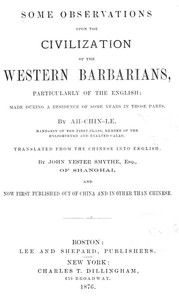
Some Observations Upon the Civilization of the Western Barbarians, Particularly of the English made during the residence of some years in those parts. Book Summary
Introduction
This summary covers "Some Observations Upon the Civilization of the Western Barbarians, Particularly of the English" by an anonymous Chinese author, written during the mid-19th century. The text reflects on Western influence and presence in China during a period of significant foreign incursion and internal change, offering a perspective distinct from typical Western accounts of the era.
What is this book about?
This work is a critique of Western civilization, specifically English influence, viewed through the lens of a Chinese observer during a tumultuous time in East Asia. It examines the cultural, social, political, and economic impacts of Western powers, particularly Britain, on China during the mid-19th century. The author provides observations on Western technology, trade practices (like the Opium Wars), political systems, religious missions, and the overall demeanor of Westerners. The tone is often critical, focusing on perceived arrogance, exploitation, and the disruptive nature of Western presence compared to traditional Chinese values and governance. It serves as a primary source document offering a non-Western perspective on the challenges and changes brought by Western imperialism.
Key Lessons
1. Cultural Arrogance and Ethnocentrism: The author consistently portrays Westerners, especially the English, as culturally arrogant and fundamentally different, often viewing their own traditions and values as superior. This is evident in critiques of missionary zeal, which was seen as disrespectful to Chinese traditions and an attempt to impose Western beliefs. The author suggests this perceived cultural superiority often manifested as condescension and a belief in the necessity of Westernizing Chinese society, sometimes through coercive means. Example: The author likely critiques the activities of Protestant missionaries who sought to convert Chinese subjects, seeing them as disruptive forces undermining established social and religious structures.
2. Exploitation and Power Imbalance: A central theme is the critique of economic and political exploitation. The book details the negative consequences of unequal treaties, foreign trade advantages (like the Canton System and later treaty ports), and the use of military force (Opium Wars). The author highlights how Western powers extracted resources and demanded unfair trade terms, leading to economic drain and political subjugation for China. Example: The devastating impact of the Opium Wars and the subsequent legalization of the opium trade by the British, which crippled the Chinese economy and led to widespread addiction and social decay, is a prime example of economic exploitation detailed in such accounts.
3. Impact on Chinese Society and Identity: The text explores how Western presence and influence challenged traditional Chinese Confucian values, social hierarchy, and national identity. The author observes the dislocations caused by foreign incursion, the influx of Western ideas and goods, and the perceived erosion of Chinese cultural dominance. There's an emphasis on preserving Chinese traditions and sovereignty in the face of external pressure. Example: The author might discuss the冲击 (impact) of Western education systems, legal codes, and administrative practices introduced in treaty ports, which offered alternatives to the Confucian model and potentially threatened traditional power structures.
4. Foreigners as 'Barbarians': Despite the title acknowledging the Westerners as 'Barbarians', the author uses this term with a specific meaning – outsiders who broke the established rules and order. This term reflects a rejection of Western claims to inherent superiority and highlights the disapproval of their disruptive actions. The focus is less on racial difference and more on their violation of China's established norms and territorial integrity. Example: The author contrasts the behavior of Western merchants and soldiers against the expected conduct of previous foreign dynasties (like the Mongols or Manchus) who were integrated into the Chinese tributary system, emphasizing the fundamentally different and unwelcome nature of the 19th-century Western presence.
Is this book fit for me?
If you are interested in:
- The history of 19th-century imperialism, colonialism, and the impact of Western powers on Asia (specifically China).
- Primary source perspectives on the Opium Wars and the Second Opium War.
- Understanding the cultural and social dynamics between China and the West during a period of significant global encounter.
- Post-colonial studies or critiques of Western dominance.
- Early forms of Orientalism or the representation of the 'Other' in historical contexts.
This book provides valuable insights into how the Chinese perspective viewed and reacted to Western challenges during a transformative era.
Does it still matter today?
Yes, particularly for understanding the historical roots of contemporary international relations, the legacy of imperialism, and ongoing debates about cultural dominance, economic exploitation, and globalization. The book offers a foundational perspective on how one nation perceived itself in relation to a powerful neighbor and how external pressures reshape societies. Its critique of power imbalances and cultural insensitivity remains relevant in discussions about modern superpowers, international trade fairness, and cross-cultural interactions. It helps contextualize the long-term effects of colonial encounters and the complexities of globalization.
Given its age and specific focus (early 19th-century China), a newer book might provide more direct connections to current geopolitical issues or offer a more nuanced analysis incorporating later historical developments. For a broader understanding of the modern history of China's engagement with the West and the evolution of global power dynamics, consider reading:
suggest_book
| Reading on Gutenburg | Free reading |
| Get Paperback Version on Amazon | Buy a book |
| Suggest Book : The Scramble for Africa: The French and the Partition of a Continent Book | Get on Amazon |
Conclusion
"Some Observations Upon the Civilization of the Western Barbarians" is a significant historical text offering a rare, first-hand account from within an impacted society. It provides invaluable insight into the anxieties, criticisms, and observations of a non-Western perspective during a critical period of Western expansion and influence. While reflecting the biases and limitations of its time and author, it remains a crucial source for historians studying imperialism, cross-cultural conflict, and the complex dynamics between China and the West during the 19th century. Understanding this perspective enriches our comprehension of that era and its enduring legacies.