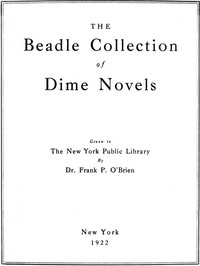
The Beadle Collection of Dime Novels Given to the New York Public Library By Dr. Frank P. O'Brien Book Summary
The Beadle Collection of Dime Novels, as presented by the New York Public Library and digitized by Project Gutenberg, isn't a single narrative but a fascinating compilation of the first wave of American popular fiction. It's a window into the cultural landscape of the mid-19th century, offering a glimpse into the stories that captivated a rapidly growing reading public.
This 'book' is actually a collection of over 30 dime novels published by Beadle and Adams between 1860 and 1886. These novels, priced at just ten cents (hence the 'dime' designation), were aimed at a mass audience and featured sensational stories of adventure, heroism, villainy, and the American frontier. The collection showcases a wide range of genres, including tales of cowboys and Indians, detectives, pirates, and historical romances. It's less about a cohesive plot and more about understanding the *form* and *content* of early mass-produced fiction.
One of the most striking lessons from the Beadle Collection is the birth of genre fiction as we know it. Before these dime novels, literature often aspired to be 'high art,' focusing on moral instruction or complex character studies. Beadle and Adams recognized a market for pure entertainment, and they catered to it by creating easily digestible stories with clear heroes and villains, and exciting plots. Stories like 'Malaeska, the Indian Wife' established tropes that would be endlessly recycled in Westerns for decades to come – the noble savage, the brave frontiersman, the conflict between cultures. This demonstrates how commercial pressures can shape literary forms.
The collection also reveals a great deal about the anxieties and aspirations of 19th-century America. The popularity of frontier tales, for example, reflects a national obsession with westward expansion, the taming of the wilderness, and the creation of a uniquely American identity. Stories often romanticized the rugged individual, capable of surviving and thriving in harsh conditions. Simultaneously, the prevalence of stories featuring outlaws and villains highlights concerns about social order and the potential for lawlessness in a rapidly changing society. The narratives weren't just escapism; they were working through national myths and fears.
Furthermore, the Beadle Collection illustrates the power of marketing and branding. Beadle and Adams weren't just publishing novels; they were building a recognizable brand. The distinctive yellow covers, the sensational titles, and the consistent focus on adventure created a strong visual identity that attracted readers. They also employed strategies like serial publication and character crossovers to keep audiences engaged. This early example of mass-market publishing demonstrates the importance of packaging and promotion in reaching a wide readership. It's a precursor to modern marketing techniques used in all forms of media.
Finally, the collection provides insight into the evolution of storytelling. While the writing quality isn't always sophisticated, the dime novels are remarkably effective at creating suspense, developing characters (albeit often stereotypical ones), and delivering satisfying resolutions. They represent a crucial step in the development of popular narrative forms, paving the way for later genres like pulp fiction, comic books, and even modern blockbuster movies. The emphasis on action and plot over nuanced character development is a hallmark of these early works and a direct influence on many forms of entertainment today.
This collection is perfect for you if:
- You're interested in the history of American literature and popular culture.
- You enjoy Westerns, adventure stories, or detective fiction and want to see their origins.
- You're a student of media studies or marketing and want to understand the early days of mass-market publishing.
- You appreciate a glimpse into the social and cultural anxieties of the 19th century.
- You don't mind somewhat melodramatic and formulaic writing – it's part of the charm!
Absolutely. The Beadle Collection is foundational to understanding the development of modern genre fiction and mass media. The tropes and storytelling techniques pioneered in these novels continue to resonate in contemporary entertainment. The sheer volume and success of the dime novels demonstrate the enduring human desire for escapism and thrilling narratives. Understanding their context helps us critically analyze the popular fiction we consume today.
Next, read Pulp: The Golden Age of American Fiction by Jess Nevins. This book builds directly on the foundation laid by the Beadle Collection, exploring the evolution of pulp magazines and their influence on subsequent genres like science fiction, fantasy, and noir. It provides a more in-depth analysis of the themes, characters, and writing styles that emerged from the pulp tradition, showing how the sensationalism and adventure of the dime novels continued to shape American fiction in the 20th century.
| Reading on Gutenburg | Free reading |
| Get Paperback Version on Amazon | Buy a book |
| Suggest Book : Pulp: The Golden Age of American Fiction Book | Get on Amazon |
The Beadle Collection of Dime Novels is more than just a historical artifact; it's a vital piece of the puzzle when understanding the evolution of storytelling and the rise of mass culture in America. While the novels themselves may not be literary masterpieces, their impact on the genres we enjoy today is undeniable, making this collection a worthwhile read for anyone interested in the roots of popular fiction.