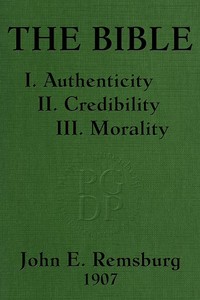
The Bible: I. Authenticity II. Credibility III. Morality Book Summary
Exploring the Bible's Enduring Legacy
This summary examines "The Bible: I. Authenticity II. Credibility III. Morality," a work that delves into the complex history, textual transmission, and ethical dimensions of one of the world's most influential texts. We'll explore its core questions, key insights, and its lasting significance.
Book Overview
The book is structured around three central themes:
- I. Authenticity: Examines the journey of the biblical texts from their likely origins to their current forms, discussing textual variations and the challenges of determining the original content.
- II. Credibility: Investigates the historical reliability of the Bible's accounts, the evidence for its divine inspiration or the human authorship behind it, and how scholarly methods assess its claims.
- III. Morality: Explores the ethical teachings within the Bible, the challenges posed by its sometimes problematic passages, and its complex relationship with modern ethical frameworks.
Key Insights
Understanding the Bible requires navigating a labyrinth of textual transmission, historical context, and ethical complexity. The book emphasizes that the Bible we read today is not necessarily the original divine word in a simplistic form, but rather a collection of texts shaped by human authors, historical circumstances, and interpretive traditions. It highlights the fascinating process of textual transmission, where scribes copied manuscripts over centuries, inevitably introducing variations. This challenges the notion of absolute, original 'authenticity' and encourages readers to appreciate the Bible as a dynamic, evolving text rather than a static, unchanging document.
Regarding credibility, the book argues against both blind faith and wholesale historical skepticism. It presents evidence for the historical context of biblical writings and the human elements involved in their creation, while also acknowledging the profound impact these texts have had on history and faith. The lesson here is that credibility isn't about proving every detail literally true in a modern scientific sense, but about understanding the text's own claims, its historical setting, and the ways it has shaped civilizations and individual lives. It encourages critical engagement rather than uncritical acceptance or rejection.
On morality, the book confronts the difficult questions surrounding the Bible's ethical content. It acknowledges that the Bible contains teachings that are laudable (like compassion and justice) alongside passages that are troubling by modern standards (like commands for war or subjugation of women). The key takeaway is that the Bible's morality is not monolithic or timeless in the way we might wish; it is rooted in its ancient Near Eastern context and has been interpreted and reinterpreted throughout history. Understanding this historical context is crucial for grappling with its ethical demands and legacy. The book doesn't dismiss these tensions but seeks to illuminate them for a modern audience.
Who Should Read This?
- If you are curious about the origins and transmission of the Bible's texts.
- If you want to understand the evidence for and against the Bible's historical claims.
- If you grapple with the Bible's moral teachings and their relevance today.
- If you are interested in the intersection of faith, history, and ethics.
- If you are tired of simplistic 'pros' and 'cons' debates about the Bible and want a more nuanced perspective.
Relevance in the Modern World
Yes, absolutely. Despite being ancient texts, the Bible remains incredibly relevant today. It continues to shape individual worldviews, cultural norms, legal systems, and social movements. Questions of authenticity, credibility, and morality addressed in the book are not just academic concerns; they have direct bearing on contemporary issues like religious freedom, bioethics, social justice, and interfaith dialogue. Our engagement with the Bible's authority and meaning in the modern age necessitates the kind of thoughtful, historically-informed analysis that this book provides. Understanding its complexities is essential for navigating its influence in our lives and society.
**Suggested Next Book:** "The Family: A World History" by Barbara D. Solomon
**Why:** This book explores the diverse ways families have been structured and understood across cultures and time periods. It complements the previous book by examining how social institutions (like the family) are interpreted through various cultural and religious lenses, including those influenced by biblical traditions. It offers a broader perspective on how texts like the Bible interact with and shape the institutions and relationships of human life.
| Reading on Gutenburg | Free reading |
| Get Paperback Version on Amazon | Buy a book |
| Suggest Book : The Family: A World History Book | Get on Amazon |
Final Thoughts
"The Bible: I. Authenticity II. Credibility III. Morality" offers a rigorous and balanced exploration of one of humanity's most significant texts. It moves beyond popular myths and simplistic answers, providing a foundation for understanding the Bible's complex journey from ancient scrolls to modern bestsellers, its claims to authority, and its enduring ethical power. While challenging, it equips readers with the tools to engage more deeply and critically with the Bible in our contemporary world.