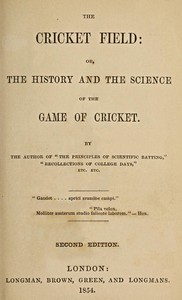
The Cricket Field: Or, the History and Science of the Game of Cricket Book Summary
The Cricket Field: Or, the History and Science of the Game of Cricket
A fascinating 19th-century exploration of the popular English game, blending history, strategy, and early scientific observation.
Book Overview
First published in 1867, "The Cricket Field" is an early comprehensive guide to the sport of cricket. Authored under the pseudonym 'Siculus,' it stands out for its detailed coverage beyond just rules. The book meticulously documents the history of cricket's development, particularly in England. It also provides an early, scientific analysis of the game's mechanics, discussing aspects like bowling action, batting technique, and fielding positions with an observational eye. Furthermore, it offers insights into the social customs, betting practices, and gentlemanly codes that surrounded the sport during its formative period.
Key Insights from the Book
One central theme is the evolution of cricket itself. The book traces its origins and charts its development from a rustic village game to a structured, popular pastime. It details the formalization of rules and the emergence of organized clubs and competitions, painting a vivid picture of cricket's social significance in 19th-century Britain.
Another crucial aspect is the scientific examination of the game. "The Cricket Field" goes beyond mere description, analyzing the physics of bowling (like the action of roundarm bowling, then a novelty) and the techniques required for effective batting and fielding. This observational approach, while rudimentary by today's scientific standards, reflects an early attempt to understand sports performance.
The book also delves into the strategic elements of cricket. It discusses tactics for captains, the placement of fielders depending on the bowler and batsman, and the psychology of the players. It explores the nature of fouls, the umpire's role, and the controversies that can arise during a match. Understanding these elements was key to playing and enjoying the game at a higher level.
Furthermore, the book captures the spirit and culture of cricket during its golden age. It touches upon the social customs of players (often amateurs from the upper classes), the prevalence of betting, the importance of public schools and universities in nurturing talent, and the early beginnings of international competition, particularly between England and Australia.
Who Should Read This Book?
This book is ideal for:
- History Buffs: Those interested in the social and cultural history of 19th-century England will appreciate the book's detailed descriptions of life around the cricket field.
- Cricket Enthusiasts: Players and fans of cricket will find value in understanding the game's historical roots, its evolution of rules, and the strategic thinking that has always been central to it.
- Students of Sports History: The book offers a unique perspective on how sports were analyzed and understood in the past, blending practical knowledge with early forms of sports observation.
- Those interested in Pseudonyms and 19th-Century Literature: The book itself is an artifact of its time, written under a pen name, offering a glimpse into the style of commentary popular during that era.
Does It Still Matter Today?
Yes, "The Cricket Field" retains relevance today. It offers a valuable historical snapshot of how the sport was played, perceived, and governed in its early, formative stages. Understanding this history helps contemporary players and fans appreciate the traditions, the evolution of techniques (like bowling action), and the strategic nuances that have deepened over time. The book provides context for many modern cricketing concepts and the social fabric surrounding the game. It allows readers to see cricket through the lens of a different era, highlighting both continuity and change in the sport's development.
| Reading on Gutenburg | Free reading |
| Get Paperback Version on Amazon | Buy a book |
| Suggest Book : The Ashes: The Incredible Story of Cricket's Most Fought-For Trophy Book | Get on Amazon |
Conclusion
"The Cricket Field" is a charming and informative work that provides more than just rules. It serves as a window into the past, blending the history, science (as understood then), and culture of one of England's most beloved sports. While its scientific analyses are dated, its historical value and unique perspective make it a worthwhile read for anyone seeking to understand the foundations of cricket and its place in 19th-century society. It complements modern works that explore the game's contemporary landscape or its global spread.