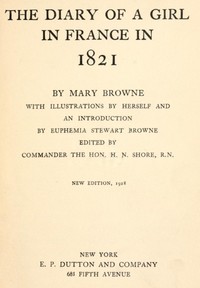
The Diary of a Girl in France in 1821 Book Summary
The Diary of a Girl in France in 1821 offers a remarkably intimate glimpse into the life of an anonymous young woman navigating the complexities of early 19th-century French society. Published posthumously, this diary wasn't intended for public consumption, lending it an authenticity often missing in historical accounts. It's a treasure for those interested in social history, particularly the daily routines, expectations, and emotional landscape of women during the Bourbon Restoration.
The book is, as the title suggests, a diary kept by a young French girl, Élise, over the course of 1821. She details her daily life, which revolves around her family, social obligations, religious observances, and, crucially, the pursuit of a suitable marriage. We follow her through visits to friends and relatives, descriptions of clothing and social events, her thoughts on potential suitors, and her internal struggles with boredom, duty, and the limited options available to women of her class. It's a slice-of-life portrayal, less focused on grand historical events and more on the subtle nuances of personal experience.
The Constriction of Women's Roles: Perhaps the most striking takeaway from Élise’s diary is the severely restricted life available to women in early 19th-century France. Her entire existence seems geared towards finding a husband, not for personal fulfillment, but for securing her family’s social and financial standing. Her days are filled with activities designed to attract a suitable match – practicing music, embroidery, and making social calls. While she displays intelligence and sensitivity, these qualities are framed within the context of making her a more desirable wife, not for developing her own intellectual pursuits. This highlights how societal expectations could stifle individual ambition and limit a woman’s agency.
The Importance of Social Networks: Élise's world is entirely defined by her network of family and friends. Information, opportunities, and even emotional support flow through these connections. A visit from relatives isn't just a social event; it's a strategic maneuver to assess potential matches and maintain family alliances. The diary vividly portrays the painstaking effort required to cultivate and maintain these relationships, emphasizing how crucial they were for navigating the social landscape and securing one’s future. This demonstrates a deeply interconnected society where individual success was heavily reliant on collective support and adherence to social norms.
The Power of Subtle Observation: Despite the limitations of her world, Élise is a keen observer of human behavior. She doesn’t offer sweeping political commentary, but her diary is filled with astute observations about the personalities, motivations, and foibles of those around her. She subtly critiques societal hypocrisy and expresses her own quiet disappointments. The diary demonstrates that even within a restrictive environment, individuals can maintain a critical perspective and find ways to express their individuality, albeit often through coded language and indirect commentary. It's a reminder that history isn't just made by grand gestures, but also by the small, everyday observations of those who lived it.
The Enduring Human Experience: While the specifics of Élise’s life are rooted in a particular time and place, her emotions – her hopes, fears, anxieties about love and acceptance – are remarkably universal. Her boredom, her longing for connection, her struggles with self-doubt, and her joy in simple pleasures resonate with readers even today. The diary serves as a powerful reminder that the fundamental human experience transcends historical boundaries, and that connecting with the past can illuminate our own present.
This book is perfect for you if:
- You enjoy historical fiction and are interested in a more authentic, firsthand account of life in the past.
- You're fascinated by social history and want to understand the daily lives of people in a different era.
- You're interested in the history of women and the challenges they faced.
- You appreciate subtle character studies and insightful observations about human nature.
- You prefer a more intimate and personal narrative over a grand, sweeping historical epic.
Yes, absolutely. While societal norms have changed dramatically since 1821, the diary’s exploration of themes like social pressure, the search for identity, and the constraints placed on individuals – particularly women – remain relevant today. The book encourages reflection on how far we’ve come, and how much further we need to go in achieving true equality and individual freedom. Furthermore, it highlights the importance of preserving personal narratives to gain a more nuanced understanding of history.
To further explore the historical context and the evolution of family dynamics, I’d suggest:
| Reading on Gutenburg | Free reading |
| Get Paperback Version on Amazon | Buy a book |
| Suggest Book : The Age of Unreason Book | Get on Amazon |
The Diary of a Girl in France in 1821 is a surprisingly compelling read. It’s a small window into a vanished world, but one that offers profound insights into the human condition. Its value lies not in dramatic events, but in the quiet authenticity of a young woman’s voice, offering a unique and valuable perspective on a pivotal moment in history. It’s a reminder that even the most seemingly ordinary lives can hold extraordinary stories.