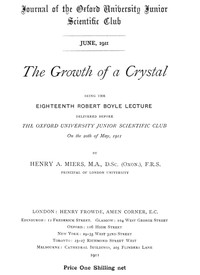
The Growth of a Crystal Being the eighteenth Robert Boyle lecture Book Summary
The Growth of a Crystal
Alan L. Mackay's "The Growth of a Crystal" delves into the fascinating world of crystal formation, using the principles of physics and mathematics to explain how these intricate structures develop. Originally delivered as the eighteenth Robert Boyle lecture, the book serves as both an educational exploration and a philosophical inquiry into the nature of order in the universe.
Book Overview
This book examines the process of crystal growth from a molecular level. Mackay explores how atoms or molecules arrange themselves to form the ordered, repeating structures we know as crystals. He uses simple physical models and mathematical equations to explain various growth phenomena, including the formation of different crystal shapes, defects, and the stability of growth forms. The text goes beyond mere description, offering insights into the fundamental principles governing the creation of order from chaos.
Key Lessons
Mackay argues that crystal growth is not merely a physical process but one governed by deep mathematical and physical principles. He explains how simple rules at the atomic level lead to complex, ordered structures. A central theme is the concept of "morphological stability", which explains why certain geometric forms persist during growth even when surface energy fluctuates. He uses the analogy of a snowflake to illustrate how the lowest-energy growth form (a facet) dominates, leading to the characteristic shape. Mackay also details the mechanisms of "spiral growth", where atoms are added at screw dislocations, allowing for the development of intricate branching patterns seen in many crystals and snowflakes. Furthermore, he discusses "surface diffusion" and how atoms move on the crystal surface before finding stable positions, influencing the growth rate and final structure. The book highlights the universality of these principles, suggesting they apply not only to inorganic crystals but potentially to other ordered structures in nature and even abstract systems like traffic flow or biological morphogenesis.
Understanding these principles helps demystify the seemingly complex process of crystallization, showing it as a manifestation of fundamental physical laws striving for equilibrium and stability. Mackay emphasizes the elegance with which nature achieves order through simple, local interactions.
Is This Book Fit For Me?
This book is ideal for:
- Students and researchers in physics, materials science, chemistry, and mathematics seeking a foundational understanding of crystal growth mechanisms.
- Anyone interested in the fundamental principles of self-organization and pattern formation in nature.
- Readers with a science background who appreciate clear, insightful explanations of complex physical phenomena.
- Those curious about the connection between atomic-scale processes and macroscopic structure.
Does It Still Matter Today?
Absolutely. The principles of crystal growth explored by Mackay are fundamental to numerous modern scientific and technological fields. Understanding crystal structure and growth is crucial for developing new materials with specific properties (e.g., semiconductors for electronics, advanced ceramics, pharmaceuticals with better bioavailability). The concepts of morphological stability, surface diffusion, and spiral growth are still actively researched and applied in materials science, condensed matter physics, and nanotechnology. While the specific examples or mathematical formalisms might be updated, the core ideas presented in this book remain relevant for understanding how order emerges from disorder in physical systems. The book provides a timeless perspective on the universality of physical laws governing structure formation.
**Suggested Next Book:** "The Physical Basis of Biology" by Manfred Eigen. This book builds on the principles of self-organization and stability, extending Mackay's ideas to the realm of molecular biology and the origin of life, showing the deep connections between different scientific disciplines.
| Reading on Gutenburg | Free reading |
| Get Paperback Version on Amazon | Buy a book |
| Suggest Book : The Physical Basis of Biology Book | Get on Amazon |
Conclusion
"The Growth of a Crystal" by Alan L. Mackay is a concise yet profound exploration of a seemingly simple phenomenon that reveals deep physical principles. Mackay masterfully uses crystal growth as a lens to examine the emergence of order, stability, and pattern formation. The book is recommended for its clarity, its insightful connection between microscopic rules and macroscopic structures, and its enduring relevance to understanding the physical world. It offers a rewarding journey into the fundamental science behind the beauty and complexity of crystalline structures.