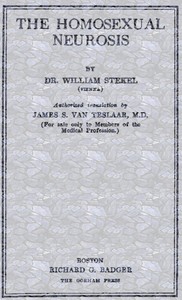
The Homosexual Neurosis Book Summary
"The Homosexual Neurosis" by Charles Berg, M.D., is a clinical study of homosexuality from a psychoanalytic perspective. Published in 1920, it reflects the medical and psychological understanding of the time, which viewed homosexuality as a mental disorder. The book aims to explore the causes, manifestations, and potential treatments of what was then termed the "homosexual neurosis."
Berg's work is rooted in the theories of Sigmund Freud and other early psychoanalysts. He examines case studies, discusses the role of unconscious conflicts, and attempts to understand the psychological underpinnings of homosexual behavior. The book is a product of its era, with terminology and perspectives that are now considered outdated and stigmatizing.
"The Homosexual Neurosis" is a clinical exploration of homosexuality from a psychoanalytic viewpoint. Berg examines the psychological and developmental factors that he believed contributed to homosexual behavior, drawing on Freudian concepts such as the Oedipus complex, castration anxiety, and the role of early childhood experiences. The book includes case studies and theoretical discussions, aiming to understand the "etiology" of homosexuality and to suggest therapeutic approaches.
Berg's work reflects the prevailing medical and psychological attitudes of the early 20th century, which pathologized homosexuality. He discusses various theories about the origins of homosexuality, including biological, environmental, and psychological factors, and considers the possibility of "curing" it through psychoanalysis.
- Psychoanalytic Perspective: Berg views homosexuality through the lens of psychoanalysis, interpreting it as a neurosis rooted in unresolved childhood conflicts. For example, he suggests that an overbearing mother and a distant father might contribute to a boy's homosexual orientation.
- Developmental Factors: The book explores how early experiences, such as trauma or inappropriate sexual exposure, might influence sexual orientation. Berg hypothesizes that certain developmental stages, if disrupted, could lead to homosexual tendencies.
- Treatment Approaches: Berg discusses the potential for psychoanalytic therapy to "cure" homosexuality by addressing the underlying neurotic conflicts. He suggests that through analysis, individuals might be able to redirect their sexual desires towards the opposite sex.
- Societal Views: The book reflects the stigmatizing attitudes of its time, portraying homosexuality as a pathological condition that deviates from the norm. This perspective has since been discredited by modern psychology.
- Case Studies: Berg uses detailed case studies to illustrate his theories, providing insights into the lived experiences of individuals who were diagnosed with "homosexual neurosis." These cases offer a window into the historical understanding of homosexuality.
This book is fit for readers interested in the history of psychology and the evolution of attitudes towards homosexuality. It provides a snapshot of early 20th-century medical and psychoanalytic thought. However, readers should be aware that the terminology and perspectives are outdated and can be offensive by today's standards.
Key points a reader will find:
- Historical context of how homosexuality was viewed in the early 1900s
- Psychoanalytic theories on the origins of homosexuality
- Case studies illustrating these theories
- Discussions on the potential for "curing" homosexuality through psychoanalysis
While "The Homosexual Neurosis" is historically significant, its views are no longer considered valid or ethical. Modern psychology recognizes that homosexuality is a natural variation of human sexuality, not a mental illness. The book's approach is stigmatizing and harmful.
Instead, readers interested in contemporary understandings of sexuality should consider more recent works that reflect current scientific and ethical standards.
| Reading on Gutenburg | Free reading |
| Get Paperback Version on Amazon | Buy a book |
| Suggest Book : Gay, Straight, and the Reason Why: The Science of Sexual Orientation by Simon LeVay Book | Get on Amazon |
"The Homosexual Neurosis" is a historical artifact that offers insight into the early psychoanalytic approach to homosexuality. While it is valuable for understanding the evolution of psychological thought, its content is outdated and offensive by modern standards. Readers seeking to understand contemporary views on sexual orientation should turn to more recent and scientifically rigorous sources.
For a modern and scientifically grounded exploration of sexual orientation, I recommend "Gay, Straight, and the Reason Why: The Science of Sexual Orientation" by Simon LeVay. This book provides an up-to-date overview of the biological and psychological factors that contribute to sexual orientation, reflecting current scientific consensus and ethical considerations.