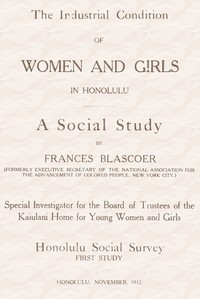
The Industrial Condition of Women and Girls in Honolulu: A Social Study Book Summary
Published in 1911, The Industrial Condition of Women and Girls in Honolulu: A Social Study by Frances Maule, offers a fascinating, and often troubling, glimpse into the lives of working women and girls in Hawaii during a period of significant social and economic change. It's a product of its time, reflecting both the progressive social research impulses of the early 20th century and the inherent biases of a Western observer studying a multi-ethnic society. This study isn't just about jobs; it's about the intersection of race, class, gender, and the impact of colonialism on the lives of vulnerable populations.
This book is a detailed investigation into the employment of women and girls in Honolulu, Hawaii, at the turn of the 20th century. Maule meticulously gathered data through interviews and observations, focusing on the types of jobs held, working conditions, wages, and the social consequences of industrial labor. She examines the employment of women from various ethnic backgrounds – Hawaiian, Japanese, Chinese, Portuguese, and Caucasian – highlighting the disparities and challenges each group faced. The study also delves into the moral concerns surrounding young women entering the workforce, particularly regarding issues of exploitation and social degradation, as perceived by the author and contemporary society.
One of the most striking lessons from the book is the sheer economic necessity driving women and girls into the workforce. Maule details how many families, particularly Hawaiian and Portuguese ones, relied on the income generated by female members to survive. This wasn't a matter of choice for many, but a desperate need to contribute to household expenses. For example, Hawaiian women, facing the decline of traditional agricultural practices and the loss of land, often found themselves working in pineapple canneries or as domestic servants, despite the arduous conditions and low pay. The book demonstrates that the narrative of women working for ‘pin money’ or personal enrichment was largely inapplicable to the majority of the women she studied.
The book also powerfully illustrates the racialized nature of labor in Honolulu. Caucasian women generally held the ‘better’ jobs – positions in shops, offices, and teaching – and commanded higher wages. Conversely, women of color were overwhelmingly concentrated in the most physically demanding, lowest-paying, and least secure occupations, such as agricultural work, laundry, and domestic service. Japanese women, while often employed in the canneries, were sometimes seen as more ‘industrious’ than Hawaiian women, leading to subtle but significant differences in treatment. This highlights how pre-existing racial hierarchies were reinforced and perpetuated within the labor market.
Furthermore, Maule’s work reveals the significant social anxieties surrounding the employment of young girls. There was a widespread fear that work would lead to moral corruption and a breakdown of traditional family values. This concern manifested in debates about minimum working ages and the need for chaperones or supervision in workplaces. While some of these anxieties were rooted in genuine concern for the well-being of young women, they also reflected a desire to control female sexuality and maintain patriarchal social structures. The author herself, while sympathetic to the plight of working women, often frames her observations through this lens of moral concern.
Finally, the study underscores the impact of colonialism and the plantation system on the lives of Hawaiian women. The displacement of Hawaiians from their land and the introduction of a wage-labor economy fundamentally altered traditional gender roles and economic practices. The demand for labor on the sugar and pineapple plantations created new opportunities for employment, but these opportunities came at a significant cost, including long hours, low wages, and exposure to harsh working conditions. The book implicitly critiques the exploitative nature of the plantation system and its detrimental effects on the Hawaiian people.
This book is ideal for readers interested in:
- Early 20th-century social history: It provides a detailed snapshot of life in Honolulu during a pivotal period.
- Women's history and labor studies: It offers valuable insights into the challenges faced by working women and girls.
- Hawaiian history and the impact of colonialism: It sheds light on the social and economic consequences of Western influence.
- Sociological research methods: It's a fascinating example of early social investigation.
- Understanding racial and class dynamics: The book clearly demonstrates how these factors shaped employment opportunities and experiences.
Yes, this book absolutely still matters today. While the specific context of early 20th-century Honolulu is unique, the issues it raises – economic inequality, racial discrimination in the workplace, the exploitation of vulnerable workers, and the challenges of balancing work and family – remain profoundly relevant. The book serves as a powerful reminder that these problems are not new and that addressing them requires a nuanced understanding of their historical roots. It also prompts us to critically examine our own assumptions about work, gender, and race.
To further explore these themes, I suggest reading:
| Reading on Gutenburg | Free reading |
| Get Paperback Version on Amazon | Buy a book |
| Suggest Book : Nickel and Dimed: On (Not) Getting By in America Book | Get on Amazon |
The Industrial Condition of Women and Girls in Honolulu is a challenging but rewarding read. It’s a historical document that offers a valuable perspective on the lives of women and girls in a rapidly changing society. While the author’s perspective is shaped by her time and background, the book’s detailed observations and insightful analysis continue to resonate with contemporary concerns about social justice and economic equality. It’s a crucial piece for anyone seeking to understand the complexities of labor, gender, and race in the context of colonialism and industrialization.