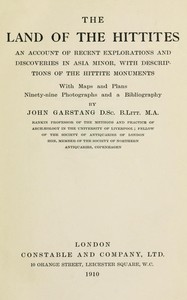
The land of the Hittites Book Summary
Introduction
'The Land of the Hittites' is a work by the renowned American archaeologist William F. Albright, first published in the mid-20th century. The book primarily serves as an introduction to the ancient kingdom of the Hittites, a Bronze Age civilization that flourished in Anatolia (modern-day Turkey) from roughly the 17th to the 12th century BC. It aims to present the archaeological findings and historical research up to that point, helping the general public understand this significant but often forgotten chapter of ancient Near Eastern history.
What is this book about?
The book delves into the geography, history, culture, and religious practices of the Hittite people. It covers their rise to power, their interactions with neighboring empires like Egypt and Assyria, their eventual decline, and their archaeological legacy. Key topics include the decipherment of the Hittite language (using the Hattian script), the contents of the Hittite royal archives discovered at sites like Hattusa (their capital), and the significance of artifacts found in the region. The book synthesizes archaeological evidence with textual sources, such as the cuneiform tablets found at the Hittite capital, providing a picture of Hittite society during its peak periods.
Key Lessons
This book illuminates the power of interdisciplinary research in understanding ancient civilizations. It demonstrates how archaeology, combined with the decipherment of ancient scripts and the analysis of historical texts, can piece together a complex narrative from often fragmentary evidence. For instance, the discovery of the Hattusa archives and the deciphering of Linear Hittite and Hieroglyphic Luwian scripts were pivotal in moving beyond vague legends (like the biblical stories of Hittites) to a detailed historical and cultural understanding.
Another crucial lesson is the importance of context. Albright emphasizes that artifacts and ruins don't exist in isolation; they must be understood within the specific historical, geographical, and cultural environment of the Hittite world. Understanding the geography of Anatolia, the climate, the trade routes, and the interactions with neighboring peoples is essential to grasping why the Hittites rose to prominence and later declined.
Furthermore, the book highlights the surprising sophistication of the Hittites. Contrary to some earlier assumptions, they were not merely 'barbarians' but developed a complex state structure, an advanced writing system, a unique religious pantheon blending Hattian and Hurrian elements with influences from the Bronze Age Mediterranean, and significant architectural achievements, including monumental palaces and fortifications. Their legal codes, such as the earliest known copy of the Laws of Hammurabi found at Kültepe, also reveal a structured society with defined social norms and justice systems.
Is this book fit for me?
Yes, this book is likely a good fit for several readers:
- Those with a general interest in ancient history and archaeology, especially readers fascinated by the ancient Near East or the Bronze Age.
- Students or enthusiasts of ancient civilizations looking for an accessible overview of the Hittites, who were contemporaries of the Egyptians, Mycenaeans, and Babylonians.
- Anyone interested in the process of historical discovery, as the book details how our understanding of the Hittites evolved through archaeological finds and decipherments.
- Readers curious about early forms of writing and literacy, given the focus on deciphering Hittite scripts.
- Those wanting to understand biblical or classical references to the Hittites, as the book provides historical context for these mentions.
However, it might be less suitable for those seeking highly specialized, cutting-edge academic research on the Hittites published in recent decades, as Albright's work, while groundbreaking in its time, represents a snapshot of Hittitology from the mid-20th century.
Does it still matter today?
Yes, 'The Land of the Hittites' still matters today for several reasons:
First, it provides foundational knowledge. While our understanding has deepened, Albright's work remains a primary source for many fundamental facts about Hittite chronology, geography, and basic cultural elements for the general reader. It established the Hittites as a major historical player in the ancient world.
Second, it showcases the ongoing importance of archaeology and textual studies in reconstructing the past. The methods and principles demonstrated in the book—contextual interpretation, the role of artifact discovery, decipherment of scripts—remain central to archaeological and historical research globally.
Third, it reminds us of the interconnectedness of ancient civilizations. Understanding the Hittites helps piece together the broader picture of interactions between Mesopotamia, Egypt, the Levant, and Anatolia during a crucial formative period.
Fourth, it highlights the value of revising historical understanding. The book serves as an example of how historical narratives can be dramatically altered by new evidence, encouraging a critical approach to history.
| Reading on Gutenburg | Free reading |
| Get Paperback Version on Amazon | Buy a book |
| Suggest Book : The Hittites: New Light on an Ancient World Book | Get on Amazon |
Conclusion
In conclusion, 'The Land of the Hittites' by William F. Albright remains a valuable resource for anyone seeking to understand this fascinating ancient civilization. It offers a clear, engaging synthesis of archaeological findings and historical research from its time, providing essential context about the Hittites' role in the ancient world, their culture, and their legacy. While modern scholarship has built upon and refined Albright's work, the book's core purpose—to introduce and illuminate the Hittites—still holds significant value for general readers and students of ancient history. It stands as a testament to the excitement of historical discovery and the enduring importance of understanding our complex past.