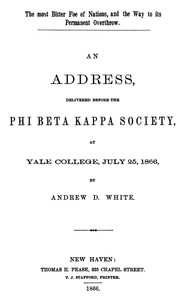
The Most Bitter Foe of Nations, and the Way to Its Permanent Overthrow Book Summary
"The Most Bitter Foe of Nations, and the Way to Its Permanent Overthrow" by John Alexander Dowie is a book that delves into the topic of alcoholism and its detrimental effects on society. Dowie was a religious leader and social reformer who was deeply concerned with the impact of alcohol consumption on families and communities. The book presents a detailed analysis of the problem and proposes a radical solution to eliminate it.
This book is about the destructive nature of alcohol and its pervasive influence on society. Dowie argues that alcohol is the root cause of many social ills, including poverty, crime, and the breakdown of families. He presents a detailed critique of the liquor trade and its supporters, and calls for the complete prohibition of alcohol as the only way to save the nation from its devastating effects. The book is both a moral and practical argument against alcohol, and it reflects Dowie's deep religious convictions and his commitment to social reform.
- Lesson 1: Alcohol is a major societal evil. Dowie argues that alcohol is responsible for a wide range of social problems, including poverty, crime, and the destruction of families. He presents statistics and anecdotes to support his claim that alcohol is a major contributor to societal decay.
- Lesson 2: Prohibition is the only solution. Dowie believes that the only way to eliminate the problems caused by alcohol is to ban it completely. He argues that half-measures, such as temperance or regulation, are insufficient and that a complete prohibition is necessary to protect society.
- Lesson 3: The liquor trade is morally corrupt. Dowie condemns the liquor trade as a morally bankrupt industry that profits from the misery of others. He argues that those involved in the production and sale of alcohol are complicit in the destruction of families and communities.
- Lesson 4: Religious and moral reform is essential. Dowie believes that a deep religious and moral transformation is necessary to overcome the problem of alcohol. He calls for a return to Christian values and a rejection of the vices that lead to alcohol abuse.
- Lesson 5: Individuals have a responsibility to fight against alcohol. Dowie encourages individuals to take a stand against alcohol and to actively work towards its elimination. He believes that every person has a role to play in the fight against this societal evil.
This book is fit for you if you are interested in the history of social reform, the temperance movement, or the role of religion in addressing social issues. It is also relevant if you are concerned about the impact of alcohol on society and are looking for historical perspectives on the issue. However, the book is written from a very specific religious and moral perspective, and may not appeal to those who do not share Dowie's views.
The issue of alcohol and its impact on society is still relevant today, although the context and specific concerns have evolved. While Dowie's call for complete prohibition may not be widely supported today, the debate over the regulation and control of alcohol continues. The book provides a historical perspective on the temperance movement and the efforts to address alcohol-related problems, which can be informative for understanding contemporary discussions.
| Reading on Gutenburg | Free reading |
| Get Paperback Version on Amazon | Buy a book |
| Suggest Book : The Family: A World History Book | Get on Amazon |
"The Most Bitter Foe of Nations, and the Way to Its Permanent Overthrow" is a passionate and detailed critique of alcohol and its effects on society. While its call for complete prohibition may be seen as extreme by modern standards, the book provides valuable insights into the historical context of the temperance movement and the moral and religious arguments against alcohol. For those interested in the history of social reform and the role of religion in addressing social issues, this book is a worthwhile read.