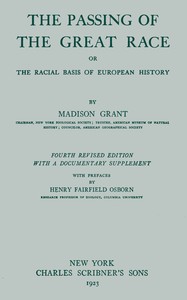
The passing of the great race; or, The racial basis of European history Book Summary
Introduction
\n"The Passing of the Great Race" by Madison Grant, published in 1916, stands as a foundational text in the history of racial pseudoscience and eugenics, though its arguments are now widely discredited and deeply problematic. The book posits a theory of racial hierarchy, arguing that the Nordic race, often associated with the ancient Aryans, was the superior race in human history. Grant, a prominent American lawyer, author, and conservationist, used scientific (and pseudo-scientific) language to advocate for the preservation and 'passing' of this supposed master race, fearing its decline due to 'mongrelization' or interbreeding with other groups. His work was highly influential in the early 20th century, contributing to the rise of eugenics movements and playing a role in discriminatory immigration laws and policies in the United States and beyond. Understanding this book requires awareness of its historical context, its controversial nature, and its significant impact, however negative, on society.
\nWhat is this book about?
\n"The Passing of the Great Race" argues that human history is driven by the actions of a superior Nordic race, which Grant believed originated in Europe. He claimed this race possessed traits like intellectual brilliance, physical prowess, courage, and creativity, and was the master race responsible for Europe's greatest achievements. Grant used historical examples and contemporary pseudo-science to supposedly prove the existence and decline of this race. He expressed deep忧虑 about the dilution of Nordic blood through intermarriage with other 'lesser' races, which he believed threatened the future of civilization. The book advocates for limiting immigration and promoting eugenic policies to preserve and strengthen this supposed 'Great Race' for the future, framing these actions as necessary for the survival and dominance of humanity's best elements.
\nKey Lessons
\nWhile now considered deeply flawed and harmful, "The Passing of the Great Race" offers a historical lesson in the application of pseudoscience and the dangers of racial determinism. Grant masterfully used selective historical interpretation and dubious scientific claims to construct a narrative of racial hierarchy. He borrowed heavily from discredited anthropological and biological theories of the time, particularly those related to the 'Aryan' theory and concepts of 'race' and 'blood purity'. The book demonstrates how language can be weaponized; Grant used terms like 'Nordic', 'Aryan', and 'Teutonic' to evoke a specific lineage and imply inherent superiority, influencing cultural and political thought. It's a stark reminder of how ideologies can be packaged in scientific-sounding language to justify prejudice, discrimination, and policies aimed at controlling populations. Understanding Grant's arguments helps illuminate the historical roots of Nazism and other extreme nationalist movements that followed.
\nIs this book fit for me?
\nThis book is primarily a historical document, essential for understanding the rise of eugenics, racial theory, and certain strands of early 20th-century nationalism. It is crucial reading for students of history, particularly those focusing on World War I, the interwar period, the Holocaust, or the history of science and pseudoscience. Readers interested in the social and intellectual currents of the early 20th century might find value in it. However, it is not suitable for casual reading due to its overtly racist and xenophobic viewpoints, which are presented with an air of scientific authority. Grant's arguments are based on flawed and biased interpretations. It offers little constructive perspective on human potential or societal progress. Approach it with caution and critically, recognizing it as a product of its time and a dangerous ideology.
\nDoes it still matter today?
\nYes, absolutely. While the specific theories Grant advanced have been thoroughly debunked by modern genetics and anthropology, the underlying issues of racism, eugenics, and the manipulation of science and history to justify discrimination remain profoundly relevant. The book serves as a stark warning about the potential for pseudoscientific racism and the normalization of harmful ideologies. Its ideas contributed to laws restricting immigration, forced sterilizations, and ultimately, genocide. Understanding how such ideas were constructed and gained traction is vital for combating contemporary forms of racism, xenophobia, and the resurgence of eugenic thinking in some circles. Ignoring the book's legacy would be a mistake.
\nThe next book to read should be a counter-narrative that debunks these racist ideologies and promotes a more equitable understanding of humanity. "The Peculiar Science" by Ruth Gomberg-Kannot is a recommended read.
\n| Reading on Gutenburg | Free reading |
| Get Paperback Version on Amazon | Buy a book |
| Suggest Book : The Peculiar Science Book | Get on Amazon |
Conclusion
\n"The Passing of the Great Race" is a significant, albeit deeply troubling, artifact of early 20th-century thought. Its core thesis of racial hierarchy and its call for restrictive policies based on pseudoscientific beliefs were influential but ultimately rejected by modern science and human rights principles. Reading it today serves as a crucial historical lesson, exposing the mechanisms by which dangerous ideas can be disseminated and the devastating consequences they can have. It underscores the importance of critical thinking, scientific literacy, and vigilance against racial prejudice. While not recommended for general consumption due to its harmful content, understanding its arguments and historical impact is essential for anyone seeking to comprehend the roots of modern racism and the ongoing fight for equality and human rights.
\n