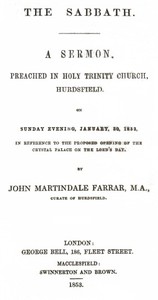
The Sabbath a sermon preached in Holy Trinity Church, Hurdsfield, on Sunday Evening, January 30, 1853, in reference to the proposed opening of the Crystal Palace on the Lord's day Book Summary
Introduction
This sermon, delivered in 1853 by the esteemed Victorian writer and clergyman Charles Kingsley, stands as a powerful critique of the encroaching commercialism upon the sanctity of the Lord's Day. Addressed to his congregation in Hurdsfield, Kingsley passionately argues against the burgeoning trend of opening shops, factories, and public venues like the Crystal Palace (a marvel of its time) on Sunday. He sees this not merely as a practical matter, but as a profound spiritual and moral issue, questioning the very essence of what the Sabbath was meant to be. He challenges his listeners to reclaim the day for its intended purpose: rest, worship, and renewal, rather than allowing it to be absorbed into the relentless cycle of the marketplace.
What is this book about?
"The Sabbath" is a sermon, not a lengthy treatise, but it packs a significant theological and social critique. Kingsley uses the specific example of the Crystal Palace opening on Sunday to illustrate a broader problem: the desecration of the Sabbath by commercial activities. He argues that allowing public entertainment and business to operate on the Lord's Day diminishes the reverence and rest that the Sabbath should afford both God and humanity. He calls for a return to the original spirit of the Sabbath, emphasizing its role as a day set apart for spiritual communion, reflection, and communal rest, free from the pressures and demands of the working week and the marketplace. He views the commercialization of Sunday as a symptom of a larger societal shift towards prioritizing material gain over spiritual well-being and moral duty.
Key Lessons
Kingsley's sermon offers several enduring lessons. Firstly, it powerfully distinguishes between rest and mere cessation of physical labor versus the need for spiritual and moral renewal. He argues that the Sabbath was meant not just to provide a break from work, but to engage the soul in worship and contemplation. Secondly, it serves as a timeless reminder of the tension between faith and materialism. Kingsley sees the drive to profit, even on the Sabbath, as fundamentally at odds with the spirit of Christianity. He questions how we can truly honor God by profaning the day dedicated to Him. Thirdly, the sermon champions the concept of Sabbath as a communal obligation. It's not just an individual choice but a societal responsibility to protect the day for the benefit of the entire community, ensuring everyone has access to rest and religious observance. Lastly, Kingsley provides a compelling critique of hypocrisy, pointing out the inconsistency between professed Christian values and the reality of Sunday commerce, urging genuine repentance and change.
Is this book fit for me?
This sermon is ideal for readers interested in the intersection of religion, social history, and morality in the 19th century. If you are exploring the history of the Sabbath, the impact of industrialization and capitalism on traditional values, or the relationship between faith and economics, Kingsley's passionate plea is highly relevant. It offers insights into the concerns and debates of Victorian society that resonate with ongoing discussions about work-life balance, consumer culture, and the commercialization of public spaces, even on days supposedly set aside for rest. It's a concise but thought-provoking piece that requires only a moderate reading commitment.
Does it still matter today?
Yes, absolutely. While the specific context (the Crystal Palace, the Industrial Revolution) is different, the core issues Kingsley addressed remain profoundly relevant. The tension between faith and commerce continues; many religious communities still grapple with how to observe the Sabbath or Sunday in an increasingly commercial world. The debate over commercial activity on Sundays (or other religious holidays) persists in many places. Kingsley's call for prioritizing spiritual rest and moral duty over material gain strikes a chord in contemporary discussions about burnout, overwork, consumerism, and finding meaning beyond relentless productivity. His arguments about the desecration of holy time by worldly concerns are as pertinent now as they were in 1853.
| Reading on Gutenburg | Free reading |
| Get Paperback Version on Amazon | Buy a book |
| Suggest Book : The Protestant Ethic and the Spirit of Capitalism Book | Get on Amazon |
Conclusion
"The Sabbath" remains a potent and historically significant sermon. Charles Kingsley's 1853 plea against profaning the Lord's Day with commerce is a powerful reflection on the enduring struggle between spiritual values and materialistic pursuits. It provides valuable historical context for understanding how social and economic changes have impacted religious observance and highlights timeless concerns about the proper use of time and resources. While not a modern text, its insights into the relationship between faith, work, and society make it a worthwhile read for anyone interested in these fundamental questions. It is a concise yet impactful piece of religious and social commentary that continues to resonate today.