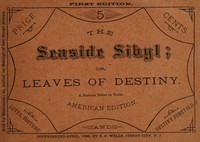
The Seaside Sibyl; Or Leaves of Destiny: A Fortune Teller in Verse Book Summary
The book centers around The Seaside Sibyl, a woman who claims the ability to foresee destinies. She is presented not as a traditional, mystical figure, but as someone who communicates her insights through poetry. The term "Leaves of Destiny" suggests a collection of individual prophecies or insights into fate, much like turning over leaves to reveal what's hidden beneath.
While not a systematic treatise on divination, the verses explore encounters with the Sibyl, her interpretations of events and people, and the often enigmatic nature of her predictions. The setting is typically coastal, lending a sense of liminality and transition. The work delves into themes of fate, free will, the power of perception, and the human desire to understand the future, all filtered through the uniquely poetic lens of Gordon's verse.
The Power of Perception and Subjectivity: The Sibyl's interpretations highlight how meaning is constructed. What she perceives as destiny might be influenced by her own intuition or perspective. Her "truths" are not necessarily objective facts but subjective interpretations offered through poetic language. This reminds us that our understanding of events, even seemingly fated ones, is colored by our individual viewpoints and the stories we tell ourselves.
Art as a Medium for Ambiguity and Revelation: Gordon uses verse to convey the Sibyl's messages. Poetry allows for ambiguity, metaphor, and evocative imagery, which suits the nature of prophecy. It doesn't provide clear-cut answers but rather suggests possibilities, emotions, and atmospheres. This suggests that complex human experiences and future possibilities are often better captured in the nuanced language of art rather than dry factual statements.
The Human Quest for Meaning and Control: Characters seeking the Sibyl often do so because they are grappling with uncertainty or seeking direction. These verses explore the deep human need to find patterns, predict outcomes, and gain a sense of control over the unpredictable flow of life. The Sibyl represents a potential source of meaning, even if her pronouncements are cryptic or unsettling, reflecting our innate desire to make sense of the unknown.
The Intersection of Secular 'Magic' and Poetry: The book blurs the lines between traditional mysticism and literary artistry. The Sibyl's role is defined by her poetic interpretations rather than supernatural powers in a conventional sense. This suggests that the intangible, the mysterious, and the seemingly magical aspects of life can be effectively explored and given form through the imaginative and suggestive power of poetry itself.
If you enjoy reading poetry, especially from the 19th century, you will likely appreciate this work. It is a collection of verse, so a taste for literary form and language is important. You might find it fitting if:
You are interested in the intersection of literature and the occult, or supernatural elements presented subtly.
You enjoy philosophical or thought-provoking poetry that makes you consider fate, free will, and human nature.
You appreciate the atmospheric and suggestive style of Victorian verse.
You are curious about lesser-known works by authors related to famous historical figures like Lord Byron.
Yes, the themes explored in "The Seaside Sibyl" remain relevant today. Our modern world still deals with uncertainty, the search for meaning, and questions about fate versus free will. While the specific format of a seaside fortune teller in verse might seem dated, the underlying questions are timeless. People still seek guidance, try to understand complex events, and look for patterns or meaning in their lives. The book's exploration of subjective truth and the limitations of perception offers insights that can still resonate with contemporary readers grappling with information overload and the complexities of modern existence.
| Reading on Gutenburg | Free reading |
| Get Paperback Version on Amazon | Buy a book |
| Suggest Book : The Alchemist Book | Get on Amazon |
In conclusion, "The Seaside Sibyl; Or Leaves of Destiny" offers a unique blend of poetry, mysticism, and philosophical inquiry. It uses verse to explore enduring human concerns about the future and the nature of reality. While perhaps not a mainstream bestseller, it provides a fascinating glimpse into the Victorian imagination and the power of poetic expression. If you enjoy its blend of ambiguity, artistry, and deeper reflection, you might want to explore another book that deals with destiny and finding one's path, such as "The Alchemist" by Paulo Coelho.