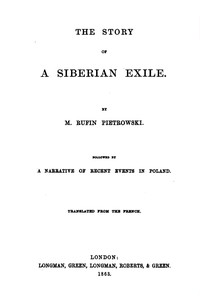
The Story of a Siberian Exile; Followed by a Narrative of Recent Events in Poland Book Summary
Introduction
This book, 'The Story of a Siberian Exile; Followed by a Narrative of Recent Events in Poland', is a work from the 19th century that combines personal narrative with political commentary. It details the harrowing experiences of an individual exiled to the remote and harsh conditions of Siberia under the Russian Empire, as well as observations and accounts of significant political turmoil occurring in Poland during a period of intense struggle for independence.
What is this book about?
The book is divided into two main parts. The first part chronicles the personal ordeal of the author (believed to be George Borrow, known for his travel writings) who was exiled to Siberia. It offers a vivid, often grim portrayal of life in a Russian prison, the journey to the exile's destination, and the subsequent existence under constant surveillance and in extreme hardship.
The second part shifts focus to 'Recent Events in Poland'. This section documents the political unrest and the ongoing struggle for Polish independence against the backdrop of the powerful Russian Empire. It provides contemporary accounts of the Polish insurrections and the suppression of national identity and rights within the Russian-controlled territories.
Key Lessons
The book offers powerful insights into the human condition under oppression and the resilience required to maintain identity. One major lesson is the brutalizing effect of state-sanctioned exile and isolation. The author's detailed descriptions of Siberia reveal how extreme physical hardship, coupled with psychological torment and cultural severance, strips individuals of their former lives and often leads to profound despair or numbness, yet can also forge unexpected inner strength.
Another crucial takeaway is the stark contrast between state power and individual dignity. The narrative demonstrates how political dissent and national identity could be crushed, yet the spirit of the oppressed individuals often refused to be entirely extinguished. This highlights the inherent tension between the machinery of imperial control and the innate human desire for freedom, self-determination, and cultural expression.
Furthermore, the accounts from Poland provide a historical lens on the consequences of imperial domination and suppression of national aspirations. The book implicitly teaches about the fragility of autonomy and the long, often violent, struggles required for nations to assert their independence and preserve their unique identities against overwhelming external forces. It underscores the human cost of such conflicts and the resilience needed from both the oppressed and their liberators (in the case of Poland, the struggle was complex, involving internal divisions and external pressures).
Is this book fit for me?
If you are interested in historical narratives focusing on the 19th-century European experience, particularly the impact of political exile or imperial rule, you may find this book valuable. It offers a raw, albeit subjective, perspective on life under oppression that is difficult to find elsewhere. Readers interested in the history of Poland's struggle for independence, the workings of the Russian Empire, or the social conditions of the time might also appreciate the specific insights provided. However, the writing style, while authentic for its period, can be somewhat dated and occasionally challenging due to the grim subject matter and lack of modern narrative techniques.
Does it still matter today?
Yes, this book remains relevant. Its exploration of themes like political exile, the suppression of national identity, state violence, and the psychological impact of oppression resonates powerfully in our contemporary world. We still see echoes of these issues in modern conflicts, debates over national sovereignty, refugee crises, and the treatment of ethnic or political minorities by states seeking to control or assimilate them. The book serves as a stark historical reminder of how unchecked state power can brutalize individuals and nations, and the enduring human struggle for dignity, freedom, and self-determination against such forces.
| Reading on Gutenburg | Free reading |
| Get Paperback Version on Amazon | Buy a book |
| Suggest Book : The Gulag Archipelago Book | Get on Amazon |
Conclusion
In conclusion, 'The Story of a Siberian Exile; Followed by a Narrative of Recent Events in Poland' is a significant, though challenging, piece of 19th-century historical literature. It provides a firsthand, harrowing account of exile and political repression, offering valuable insights into the human cost of empire and the struggle for national identity. While the style and specific historical context differ greatly from modern writing, its core themes of suffering, resilience, and the fight against oppression continue to resonate and are essential for understanding certain aspects of human history and ongoing global issues.