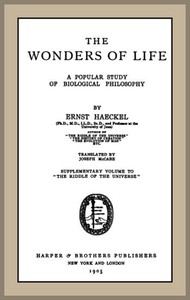
The Wonders of Life: A Popular Study of Biological Philosophy Book Summary
Welcome to the World of Biological Philosophy
Embark on a journey into the fascinating intersection of biology and philosophy with this summary of 'The Wonders of Life'. This book, written in the early 20th century, offers a unique perspective on understanding life through scientific inquiry and philosophical reflection. It's a primer that invites readers to explore the profound questions surrounding the nature of life, its origins, and its development, all grounded in the scientific method.
A Popular Study of Biological Philosophy
"The Wonders of Life" is an accessible exploration of the philosophical underpinnings of biological science. It delves into how we observe, interpret, and reason about the living world, focusing particularly on the implications and evidence surrounding evolutionary theory. The author presents complex ideas in a clear and engaging manner, making it suitable for a general audience without requiring prior specialized knowledge. The book emphasizes observation, inference, and the tentative nature of scientific understanding, positioning biology not just as a collection of facts, but as a dynamic, reasoning-based discipline seeking to unravel the mysteries of life's complexity and diversity.
Key Insights
The book champions a philosophical approach to biology, urging readers to consider the fundamental questions: How do we know what we know about life? What are the limits of biological explanation? It emphasizes that biology is not merely descriptive but actively seeks causal explanations for the phenomena observed in nature.
A central theme is the power and necessity of evolution through natural selection. The author explains how this process, driven by variation, inheritance, and differential survival, leads to adaptation and the diversity of life we see. It's presented as the unifying framework for understanding the history and development of all living organisms.
The book also highlights the importance of empirical evidence and logical reasoning in biological inquiry. It discusses how observations of fossils, embryology, geographical distribution, and artificial selection provide support for evolutionary theory. Furthermore, it touches upon the concept of 'teleology' (the idea that living things have purposes or goals) versus 'final causes', arguing for a mechanistic understanding based on natural laws rather than pre-ordained design.
Finally, it reflects on the broader implications of a biological worldview, encouraging readers to appreciate the intricate, interconnected nature of life on Earth and the remarkable processes that have shaped it over billions of years.
Who Should Read This Book?
This book is ideal for:
- Individuals interested in the philosophy of science and biology.
- General readers seeking a clear and engaging introduction to evolutionary theory and its philosophical context.
- Those curious about how scientists think about and understand the natural world.
- Students of biology, philosophy, or the history of science looking for foundational perspectives.
- People who appreciate well-argued, eloquent writing that makes complex ideas accessible.
Enduring Relevance
Absolutely. While written over eighty years ago, the core questions and philosophical underpinnings explored in "The Wonders of Life" remain profoundly relevant. Our understanding of evolution, genetics, and the mechanisms of natural selection has only become more detailed and robust since the book was first published. The fundamental challenge of reconciling observed complexity with natural processes, the ongoing debates about evolutionary mechanisms, and the philosophical questions surrounding life's origins and meaning continue to shape scientific research and public discourse.
Understanding the principles of biological philosophy helps navigate modern issues like climate change impacts on biodiversity, the ethics of genetic engineering, the validity of intelligent design arguments, and appreciating the unity and history of life on Earth. The book provides a historical perspective on how these very topics were being conceptualized and debated in the early 20th century, adding a layer of historical context to current scientific understanding.
Suggested Next Book: "The Descent of Man" by Charles Darwin
This book delves into the specifics of human evolution, providing direct evidence and arguments from the originator of the theory of natural selection. It complements "The Wonders of Life" by offering a primary source account of the evidence for evolution, particularly concerning human origins and behavior, and the intellectual journey leading to Darwin's revolutionary ideas.
| Reading on Gutenburg | Free reading |
| Get Paperback Version on Amazon | Buy a book |
| Suggest Book : The Descent of Man Book | Get on Amazon |
Conclusion
"The Wonders of Life" serves as an insightful gateway to appreciating the deep philosophical questions that underpin biological science. It effectively communicates the awe-inspiring nature of life and the power of evolutionary theory as a framework for understanding it. While a product of its time, its exploration of observation, inference, and the explanatory power of natural selection continues to resonate, offering readers a timeless perspective on one of the most fundamental aspects of our existence. It's a valuable read for anyone seeking to understand not just 'how' life works, but 'why' we might think we understand it through the lens of science.