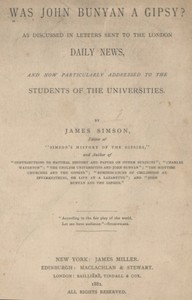
Was John Bunyan a Gipsy? Book Summary
Introduction
This book, "Was John Bunyan a Gipsy?" by George Croly, delves into the intriguing possibility that the renowned English author and preacher, John Bunyan, may have had Gipsy (or Roma/Gypsy) ancestry or associations. While Bunyan is best known for his allegorical masterpiece, "Pilgrim's Progress," this work explores the less-charted territory of his potential connection to the Romani people. The book examines historical records, Bunyan's own writings, and the social context of 17th-century England to build a case for this hypothesis, adding a layer to the already complex figure of Bunyan's life and background.
What is this book about?
The central question of the book is whether John Bunyan, the author of the beloved classic "Pilgrim's Progress," had any links to the Gipsy (or Roma) community. Bunyan lived during the 17th century in England, a time when social mobility and migration were significant, and unusual origins were not always hidden. The book investigates this possibility by exploring Bunyan's biography, his family background, his language (which contained some unusual words), and accounts of his appearance and mannerisms. It looks at historical records from the period, the possibility of intermarriage between different groups, and the presence of Gipsies in England during Bunyan's lifetime. The author, George Croly, presents evidence and arguments suggesting that Bunyan might indeed have had Gipsy ancestry, portraying him as a man with a unique and perhaps more diverse heritage than previously acknowledged.
Key Lessons
1. Re-evaluating Historical Figures: The book teaches us to look beyond the commonly accepted narratives and appearances of historical figures. Bunyan is often seen as a simple, godly man, but "Was John Bunyan a Gipsy?" encourages us to consider the possibility of hidden depths, complexities, and diverse backgrounds that might have shaped his unique perspective and experiences. It shows how our understanding of historical individuals can be enriched by exploring less obvious connections and challenging stereotypes.
2. The Significance of Ancestry and Heritage: This work highlights how ancestry, even from groups considered 'outsiders' or 'different', can influence a person's identity, worldview, and even their language or behavior. Examining Bunyan's possible Gipsy roots suggests that his unconventional language or certain aspects of his character might have roots in his heritage, adding a new dimension to his already complex life story.
3. Social History and Migration: The book provides a window into the social fabric of 17th-century England. It touches upon the presence and lifestyle of the Gipsy community during that period, the fluidity of social boundaries, and the potential for intermarriage and integration between different groups. This helps readers understand the broader historical context in which Bunyan lived and the societal norms (or lack thereof) regarding migration and mixed ancestry.
4. The Power of Questioning Conventional Wisdom: "Was John Bunyan a Gipsy?" demonstrates how asking 'what if' questions about established historical facts can lead to fascinating discoveries and revised understandings. It shows that history is not a closed book but a field open to reinterpretation and fresh investigation based on existing evidence.
Is this book fit for me?
If you are interested in the life of John Bunyan beyond his famous allegory, or fascinated by questions of identity, ancestry, and hidden histories, this book offers intriguing food for thought. It is suitable for:
- Readers interested in John Bunyan or 17th-century English history.
- Those curious about Gypsy (Roma) history and culture.
- Students or enthusiasts of historical biography and textual analysis.
- Anyone interested in how historical figures might have had complex or hidden backgrounds.
However, it might not be ideal if you are primarily interested in reading "Pilgrim's Progress" itself, or if you prefer strictly factual biographies without speculative elements.
Does it still matter today?
Yes, this exploration of Bunyan's potential Gipsy ancestry still matters today. It encourages a deeper, more nuanced understanding of historical figures and the complex tapestry of human identity. In a world where discussions about heritage, migration, and social integration are increasingly relevant, re-examining the backgrounds of historical figures reminds us that ancestry and cultural heritage can shape individuals in subtle and significant ways. It also highlights the importance of looking beyond surface appearances and common assumptions. Furthermore, it contributes to a richer understanding of the diverse roots that make up the English (and indeed, all national) identity, challenging monolithic views of the past.
| Reading on Gutenburg | Free reading |
| Get Paperback Version on Amazon | Buy a book |
| Suggest Book : The Gypsies: A European Story Book | Get on Amazon |
Conclusion
"Was John Bunyan a Gipsy?" is a thought-provoking and meticulously researched exploration into the background of a foundational figure of English literature. While it presents a speculative case, its strength lies in its careful examination of historical possibilities and its challenge to conventional views of Bunyan. It offers readers a fresh perspective on a familiar character, reminding us that history is often more complex and layered than we initially suppose. The book's exploration of identity, heritage, and historical context remains relevant, encouraging us to question assumptions and delve deeper into the lives of those who came before us.