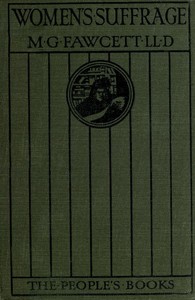
Women's Suffrage: A Short History of a Great Movement Book Summary
Published in 1910 by Millicent Fawcett, Women's Suffrage: A Short History of a Great Movement offers a contemporary account of the British women’s suffrage campaign. It's a fascinating primary source, written by a central figure *within* the movement, providing an insider's perspective on the decades-long struggle for women to gain the right to vote. Fawcett, the leader of the National Union of Women's Suffrage Societies (NUWSS), known as the 'suffragists', brings a calm, reasoned, and meticulously documented approach to a topic often sensationalized.
This book chronicles the evolution of the women’s suffrage movement in Britain, starting from the early petitions and discussions in the late 1860s and extending to the parliamentary battles of the early 20th century. Fawcett details the various organizations involved, the key figures who drove the campaign, the legislative attempts made (and failed), and the changing tactics employed. She carefully distinguishes between the constitutional methods of the NUWSS and the more militant actions of the Women's Social and Political Union (WSPU), led by Emmeline Pankhurst, known as the 'suffragettes'. It's less a narrative *about* individuals and more a history of the *process* of achieving suffrage, emphasizing the arguments, the political maneuvering, and the persistent effort required.
One of the most striking lessons from the book is the sheer *length* of the struggle. The fight for women’s suffrage wasn’t a sudden upheaval, but a decades-long campaign of patient organization, lobbying, and public education. Fawcett demonstrates how early suffragists, facing immense societal resistance, began by focusing on broadening the franchise for men, believing it would create a precedent and momentum for women’s enfranchisement. This incremental approach, while sometimes frustrating, highlights the importance of strategic thinking and building alliances in achieving political change.
The book also powerfully illustrates the diverse arguments used to oppose women’s suffrage. These weren’t simply based on prejudice, though prejudice certainly existed. Fawcett details the complex reasoning – often framed as protecting women themselves – put forward by politicians and social commentators. Arguments ranged from the claim that women lacked the intellectual capacity to vote responsibly, to fears that granting them suffrage would disrupt the family structure, and the belief that women were already represented by their husbands. Understanding these historical objections provides valuable insight into the nature of entrenched power structures and the challenges of overcoming deeply held beliefs.
A crucial point Fawcett makes is the distinction between the 'suffragists' and the 'suffragettes'. The NUWSS, under her leadership, favored peaceful, constitutional methods like petitioning, lobbying MPs, and holding meetings. She details how they built a massive organization with branches across the country. The WSPU, in contrast, adopted increasingly militant tactics – demonstrations, window-smashing, and even arson – to draw attention to their cause. Fawcett explains her concerns about these methods, arguing they alienated potential supporters and undermined the movement’s credibility. The contrast shows how different strategies can coexist within a broader movement, and the debates about which tactics are most effective.
Finally, the book stresses the importance of consistent, organized effort. The NUWSS maintained a steady presence in the political landscape for decades, even during periods of public apathy or active opposition. Fawcett emphasizes the dedication of countless volunteers who worked tirelessly at the grassroots level, educating the public and building support. This highlights that lasting social change isn’t usually achieved through dramatic events alone, but through sustained commitment and the mobilization of ordinary people.
This book is ideal for readers interested in:
- British history, particularly the Victorian and Edwardian periods.
- The history of social movements and political activism.
- The women's suffrage movement specifically.
- Primary source accounts – experiencing history through the eyes of someone who lived it.
- Understanding the nuances of political strategy and debate.
It’s a relatively concise and accessible history, making it a good starting point for those unfamiliar with the topic. However, it is written from a specific perspective (that of the NUWSS) and doesn’t offer a fully neutral account of all factions within the movement.
Absolutely. While women have gained the right to vote in many countries, the book’s lessons about the challenges of achieving equal rights, the persistence of prejudice, and the importance of political organization remain remarkably relevant. The fight for full gender equality is far from over, and understanding the historical struggles that paved the way for current progress is crucial. Moreover, the debates about tactics – peaceful protest versus more disruptive action – continue to resonate in contemporary social movements.
To further explore the complexities of the suffrage movement and its legacy, I recommend reading:
| Reading on Gutenburg | Free reading |
| Get Paperback Version on Amazon | Buy a book |
| Suggest Book : Deeds Not Words: The Story of Women's Suffrage Book | Get on Amazon |
Women's Suffrage: A Short History of a Great Movement is a valuable historical document and a compelling account of a landmark struggle. Millicent Fawcett’s meticulous and reasoned narrative offers a unique perspective on the British suffrage campaign, highlighting the dedication, strategy, and perseverance required to achieve lasting political change. It's a reminder that progress is rarely easy or inevitable, and that the fight for equality demands sustained effort and a deep understanding of the forces at play.