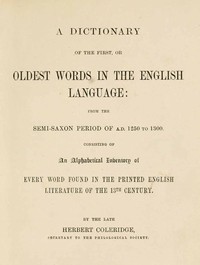
A Dictionary of the First or Oldest Words in the English Language From the Semi-Saxon Period of A.D. 1250 to 1300 Book Summary
Published in 1875, A Dictionary of the First or Oldest Words in the English Language by Skeat is a fascinating, if somewhat dry by modern standards, exploration of the very roots of our vocabulary. It's a product of its time, deeply rooted in philological research and a desire to understand the historical development of English. Walter Skeat, a prominent English philologist, meticulously traces words back to their earliest known appearances in texts, primarily those from the period between 1250 and 1300, which he defines as the 'Semi-Saxon' era.
This book isn't a dictionary in the way we typically think of one. It doesn't aim to define current usage. Instead, it's a historical investigation into the oldest documented forms of English words. Skeat examines early Middle English texts, comparing them to Old English (Anglo-Saxon) and other related Germanic languages (like Dutch, German, and Gothic) to determine when a word first appeared in its recognizable form. He focuses on words that have survived, largely unchanged, to the present day, offering a glimpse into the linguistic landscape of medieval England and the foundations upon which modern English is built.
One of the most striking lessons is the sheer age of many common English words. We often assume language is constantly evolving, and it is, but Skeat demonstrates that a surprising number of words we use daily – words like 'man,' 'wife,' 'house,' 'eat,' 'drink,' 'sleep,' 'good,' 'bad,' 'old,' 'new' – have roots stretching back over a thousand years, with forms remarkably similar to those used by our Anglo-Saxon ancestors. This highlights the incredible resilience of language and the enduring power of basic concepts.
Another key takeaway is the importance of understanding the influence of Germanic languages on English. Skeat repeatedly shows how English words are cognates – meaning they share a common ancestor – with words in other Germanic tongues. For example, the word 'brother' is closely related to the German 'Bruder' and the Dutch 'broeder.' This reinforces the idea that English isn't an isolated language but a member of a larger family, shaped by centuries of interaction and borrowing. He meticulously details how sound changes over time explain the variations between these related words.
The book also reveals the challenges of tracing linguistic history. Determining the 'oldest' word isn't always straightforward. Skeat acknowledges that the survival of texts is a factor; we only know about words that were written down. Furthermore, spelling was inconsistent in the Middle English period, making it difficult to identify the precise origin of a word. He often presents multiple possible etymologies and explains the reasoning behind his preferred conclusions, demonstrating the nuanced and sometimes speculative nature of philological research. He also points out that sometimes a word *appears* old, but its current meaning has shifted significantly over time.
Finally, Skeat’s work implicitly demonstrates the continuity of culture embedded within language. The fact that words for fundamental aspects of life – family, shelter, sustenance – have remained largely unchanged suggests a stability in the core values and experiences of English-speaking people over centuries. While societal structures and beliefs have evolved, the basic human needs and relationships reflected in these ancient words persist.
This book is ideal for:
- Linguistics enthusiasts: If you're fascinated by the history of language and how words change over time, you'll find this book a treasure trove of information.
- Etymology buffs: Those who enjoy tracing the origins of words will appreciate Skeat's detailed and scholarly approach.
- Historians (particularly of England): The book provides insights into the cultural and social context of medieval England.
- Readers interested in Old and Middle English: While not a language textbook, it offers glimpses into the forms of English used in earlier periods.
- Anyone who enjoys a deep dive into a specific, scholarly topic.
Yes, it absolutely still matters. While some of Skeat's specific conclusions have been refined or challenged by later research, his methodology and the sheer volume of evidence he presents remain valuable. The book serves as a foundational work in English etymology and demonstrates the importance of historical linguistics in understanding the present state of the language. It reminds us that language isn't static, but a living record of our past.
However, the book's style is dense and can be difficult for a casual reader. Therefore, I suggest following up with a more modern and accessible work that builds upon Skeat's foundation.
| Reading on Gutenburg | Free reading |
| Get Paperback Version on Amazon | Buy a book |
| Suggest Book : The Adventure of English: The Biography of a Language Book | Get on Amazon |
A Dictionary of the First or Oldest Words in the English Language is a remarkable achievement of Victorian scholarship. It's a challenging but rewarding read for anyone interested in the deep history of English, offering a unique perspective on the origins of the words we use every day. While a product of its time, its insights continue to resonate with linguists and language lovers alike.